LEARNING OBJECTIVES
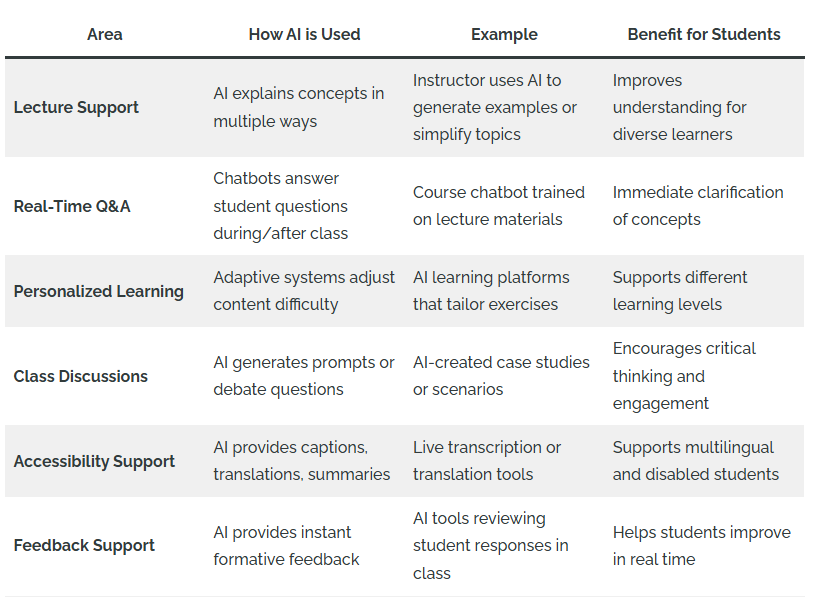
- Explain the concept of artificial intelligence (AI) by defining its core functions.
- Analyze the “promise–peril conundrum” of AI by evaluating both its potential benefits and risks in the context of higher education.
- Evaluate the role of AI tools (such as course-specific chatbots) in supporting student success and equity.
A NEW WAVE
In The Coming Wave, Mustafa Suleyman, makes the following observation about the rise and spread of technologies:
| Almost every foundational technology ever invented, from pickaxes to plows, pottery to photography, phones to planes, and everything in between, follows a single, seemingly immutable law: it gets cheaper and easier to use, and ultimately it proliferates, far and wide. – Mustafa Suleyman |
Suleyman concludes that the new technological wave humans face is AI and that unlike previous ones, this one must be actively managed to prevent catastrophic outcomes.
Enlarge Table
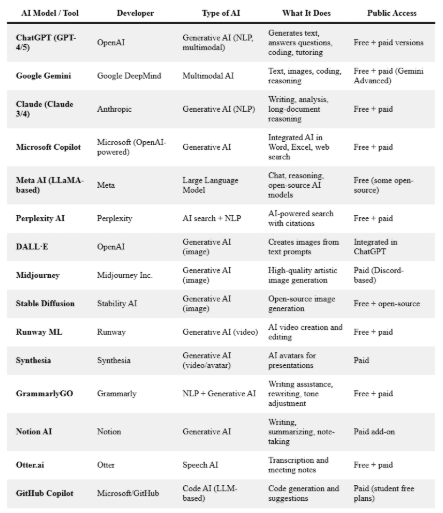
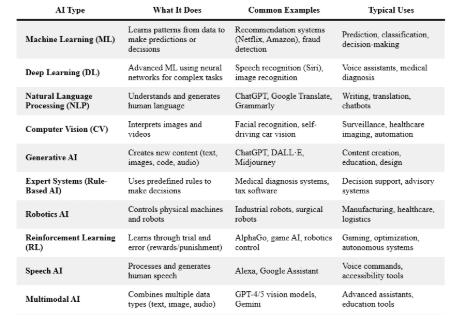
What exactly is AI, and why the concerns about its future role and function in society? AI is commonly defined as a branch of computer science that focuses on creating machines or systems capable of performing tasks that normally require human intelligence. This includes learning, reasoning, problem-solving, and decision-making. AI works by using algorithms and data to simulate human thinking. Instead of being explicitly programmed for every task, AI systems can learn from experience (data) and improve over time.
Consequently, AI cannot be defined just as a technology. Instead, it needs to be viewed as a broad and evolving multidisciplinary transformative field with applications across many areas including education, healthcare, and industry.
Enlarge Table
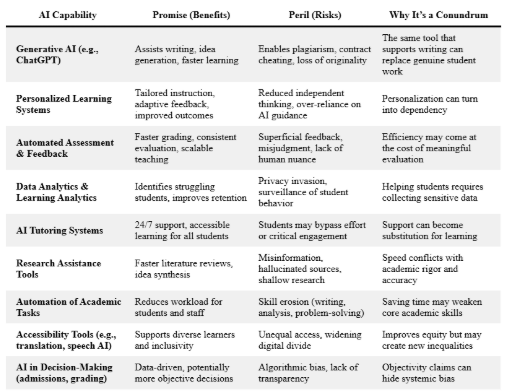
However, there is a central tension developing alongside the rise of AI. Referred to as the AI promise–peril conundrum, it explains that while AI systems can dramatically improve human life, they can also simultaneously introduce serious ethical, social, and political risks.
Research consistently shows that these benefits and harms are not separate outcomes but emerge from the same underlying capabilities such as data processing, automation, and prediction. For many, this makes AI governance critical. In other words, a way must be found to extract value from AI without amplifying harm, especially in areas like bias, privacy, and employment. This point is particularly true when one considers the integration of AI in higher education.
Enlarge Table
AI AND THE CALIFORNIA COMMUNITY COLLEGE SYSTEM
Where does the California Community Colleges Chancellor’s Offices stand on the question of AI and the future of teaching and learning?
| The California Community Colleges Chancellor’s Office (Chancellor’s Office) supports systemwide AI adoption through structured programs that center educators, practitioners, and institutional leaders. These programs focus on building internal capacity, advancing AI literacy, and supporting responsible, equity-centered use of artificial intelligence across teaching, learning, student support, and operations. – AI Innovators and Practitioners |
For California Community Colleges, “Generative artificial intelligence (GenAI) and Artificial intelligence (AI) present transformative opportunities for students, faculty, administrators and staff that could propel the California Community Colleges to the forefront of achievement for the future of learning in higher education.” In fact, Vision 2030 identifies AI as a strategic direction.
| Vision 2030 – section IV – Strategic Direction 3: Action 12: Actively engage with the impacts of generative artificial intelligence (GenAI) on the future of teaching and learning: b. Ensure all students, faculty, and staff have the fundamentals of GenAI literacy; c. Leverage innovative data infrastructure, including the Common Cloud Data Platform to apply GenAI and other big data solutions to enhance our ability to provide students with timely, proactive support, and guidance. e. Conduct analyses of the impact of GenAI technology and its potential implications for teaching and learning to inform necessary policy reform and system practices that will advance access, success, and support for our students. |
EL CAMINO COLLEGE AND AI GOVERNANCE
Although direct survey data specific to California Community Colleges is still emerging, nationwide studies suggest that AI usage among community college students likely falls between 50% and 70%, with continued growth expected. These estimated figures, along with the CCCCO stance on AI, has moved CCCs to begin establishing guideline of AI integration. In the case of El Camino College, Administrative Procedure 3775 (AP 3775) Artificial Intelligence (AI) is a first attempt at providing some direction on the use of AI. More specifically, AP 3775 establishes guidelines for the responsible adoption and use of artificial intelligence within the El Camino College District. It emphasizes that AI use in education is primarily determined by faculty, with clear expectations for transparency, academic integrity, and accommodations for students with disabilities. The policy also highlights strict requirements for data security, privacy, and compliance with existing regulations, while addressing ethical considerations such as human oversight, workforce impacts, and intellectual property protections. Additionally, it sets procedures for approval, training, monitoring, and enforcement to ensure AI technologies align with institutional goals and operate safely and effectively.
AI, STUDENT EQUITY AND THE SEA STUDENT SURVEY
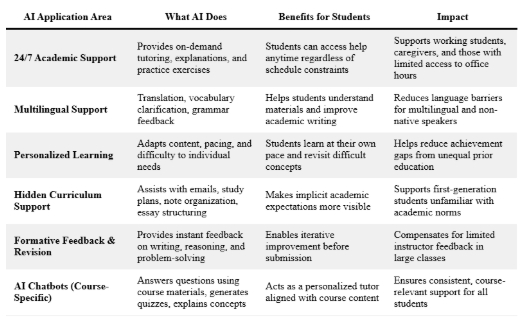
The debate about the integration of AI into higher education has led to a variety of perspectives and opinions. Examples of the risks of AI range from eroding learning to its adverse effects on student well-being. Again, the consideration of AI integration must never overlook the promise–peril conundrum. However, what cannot be dismissed is that the integration of AI into CCCs has the potential to address long-standing structural barriers experienced by historically minoritized students. This includes limited access to tutoring, fewer opportunities for individualized instruction, linguistic challenges, and competing responsibilities outside of school.
AI technologies can help mitigate some of these barriers by providing scalable, personalized, and flexible forms of academic support that extend beyond traditional classroom structures.
AI can also enhance student equity by making course content more accessible, interactive, and adaptable to diverse learning needs. Many students, particularly those balancing work, caregiving, or language barriers, may struggle to fully engage with lectures and readings in traditional formats. AI tools help address this by explaining complex concepts in multiple ways, summarizing key ideas, and generating practice questions that reinforce understanding.
Course-specific AI systems can further support student equity by acting as 24/7 tutors aligned with class materials by allowing students to revisit content, ask questions, and receive immediate feedback at their own pace. This is especially beneficial for students who may not have consistent access to instructors or academic support services. AI has the capacity to enable personalized engagement with course content and reducing barriers related to time, language, and prior preparation. AI can help create a more inclusive learning environment where all students have greater opportunities to succeed.
Enlarge Table
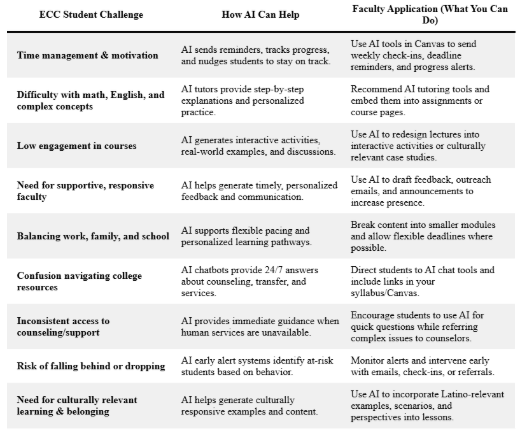
Recently, SEA at El Camino College conducted a survey of Latin(a)o and Hispanic views on learning. The study uncovered that Latina/o and Hispanic students at ECC are highly motivated and primarily focused on transferring to a four-year university, with affordability, proximity, and career preparation influencing their decision to enroll.

Many of the students surveyed value ECC’s supportive programs, inclusive environment, and opportunities for advancement, but their experiences reveal a complex set of challenges that impact their academic success. While most students indicated they have access to technology and counseling services, gaps remain in how effectively they can navigate these resources. Some reported inconsistent guidance and difficulty accessing support. AI can play a practical, faculty-centered role in addressing many of the specific challenges identified in the SEA survey by helping instructors scale the kinds of support students already say they need.
Enlarge Table
COURSE SPECIFIC CHATBOTS AS A SCALEBLE SUPPORT SYSTEM
With regards to course-based challenges faced by students, this can be addressed with the integration of a course-specific chatbot trained on materials such as lectures, readings, and assignments. The chatbot can function as a 24/7 tutoring resource that enhances both learning and equity. Because it is aligned with the course content, the chatbot can answer questions, explain concepts, generate practice problems, and guide students through assignments in ways that reflect the instructor’s curriculum and learning objectives. Its constant availability allows students to access support whenever they are studying, which is especially valuable for those balancing work, family responsibilities, or other constraints that limit access to traditional office hours or tutoring services. In addition to improving understanding, chatbots encourage active engagement by helping students test their knowledge, revise their work, and explore ideas without fear of judgment. They also support multilingual learners by simplifying language and clarifying unfamiliar terms, and they provide consistent, immediate assistance in large classes where individualized feedback may be limited. By removing time, access, and confidence barriers, course chatbots can serve as scalable student support system that promotes more inclusive and equitable learning opportunities for all students.
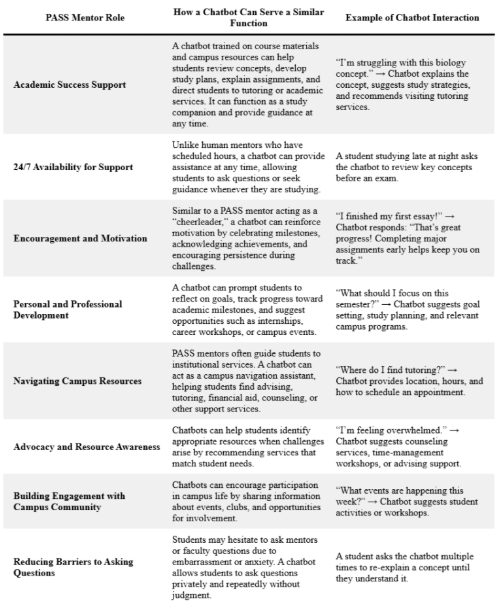
A chatbot designed around the goals of the PASS Mentor program can serve as a digital peer-support companion that guides students through their academic journey while reinforcing encouragement, connection, and belonging. Like human PASS mentors, the chatbot can provide not only academic assistance but also motivation, validation, and timely guidance. Because it is available at any time, it extends the reach of the program by ensuring that students can access support whenever they need it. Through conversational interaction, the chatbot can respond to challenges with encouragement, suggest strategies for overcoming difficulties, and celebrate student achievements such as completing assignments or reaching academic milestones, helping to reinforce a sense of progress and recognition.
Like a PASS mentor, it can prompt students to reflect on their progress, set goals, and explore career or campus opportunities, encouraging continued engagement with their educational pathway. Additionally, the chatbot can act as a guide to campus resources by answering questions about services such as tutoring, advising, or financial aid, and by directing students to appropriate support when challenges arise. This function is particularly valuable for students who may be unfamiliar with navigating college systems.
A course-specific PASS mentor chatbot can also foster a stronger sense of belonging by maintaining regular, supportive interactions and connecting students to the broader campus community. It can remind students about events, encourage participation in academic and social activities, and prompt engagement with faculty and peers. While it does not replace the relational depth of human mentorship, it complements and expands the impact of PASS mentors by providing immediate responses, routine guidance, and consistent check-ins. In this way, the chatbot functions as a scalable support system that enhances student success, promotes retention, and helps ensure that all students feel supported throughout their college experience.
Enlarge Table
APPENDIX: APPLICATION OF AI IN LEARNING ENVIRONMENTS