
LEARNING OBJECTIVES
- Define equity and explain why institutionalized analysis of disaggregated data is critical for identifying equity gaps.
- Explain what organizational learning is and why it is the framework used by myPATH as the starting point for conducting its equity work.
- Explain why race matters when addressing equity gaps.
DEFINING EQUITY
To become a practitioner of equity in higher education, one must begin with a clear and shared definition of what equity truly means and how it differs from related but distinct concepts like access and equality. This foundational understanding allows educators to move beyond surface-level solutions and begin addressing the structural, cultural, and pedagogical factors that contribute to persistent equity gaps.
If we were to ask faculty across the California Community College (CCC) system to define equity, we would likely receive a wide range of responses. That’s because our definitions are often shaped by our personal identities, social identities, and lived experiences. While this diversity of thought is valuable, it also underscores the importance of establishing a collective starting point for discussion and action.
Equity is not about equal treatment but instead it is about equal outcomes. However, it is not common for educators to inadvertently interchange the terms accessibility, equality, and equity, but they are not interchangeable. The table below highlights the differences between these terms.
Table 1: Equality, Equity and Accessibility Compared
| Concept | Definition | Key Question | Limitations |
|---|---|---|---|
| Equality | Providing the same resources, opportunities, and treatment to all students regardless of background | “Is everyone getting the same thing?” | Ignores differences in student needs; can unintentionally reinforce inequities |
| Equity | Providing tailored resources and support based on individual or group needs to achieve fair outcomes | “What does each student need to succeed?” | Requires data, coordination, and sustained effort; can be misunderstood as preferential treatment |
| Accessibility | Designing systems, environments, and materials so all students especially those with disabilities or barriers can fully participate | “Can everyone access and engage with this?” | Ensures access but not necessarily success or equitable outcomes |
For example, all students at a CCC may have equal access to course enrollment, but equal access does not guarantee equal outcomes. If one group of students consistently fails to complete or pass a course at the same rate as others, more than often, there is a tendency to focus solely on students’ abilities, behaviors, or motivations as the cause. An equity-minded approach, in contrast, examines the learning environment, instructional practices, and institutional norms that might be a cause. This approach does not assume deficits in students themselves is the cause but examines other possibilities. Thus, adopting an equity-minded perspective requires that we look inward not only at our classrooms, but also at our institution’s culture, structures, and practices to identify potential causes of inequities.
To summarize, equity in education means ensuring that each student receives what they need to succeed, recognizing that not all students begin from the same place and that some may require more or different forms of support to achieve similar outcomes. It acknowledges historical and structural disadvantages faced by historically minoritized students and seeks to correct them through intentional and systemic interventions. By grounding our work in a shared and precise definition of equity, we can better recognize and dismantle the conditions that perpetuate opportunity and achievement gaps, and ultimately design learning environments that are responsive, inclusive, and just.
In summary, equity in the classroom is not simply about ensuring students can enter the learning environment. It’s about ensuring they can succeed once they’re there. At its heart, equity is about achieving equal educational outcomes by responding intentionally to the diverse needs of students. This requires more than uniform treatment; it requires a transformation in how we think about fairness, instructional design, and student support.
| “Equity is not about equal treatment of students, but equal educational results. With equity, all students—no exceptions—are guaranteed success in school.” – Curtis Linton, The Equity Framework “A key phrase for understanding student equity data is adverse or disproportional impact. Typically, this phrase reminds educators to examine data for differences in outcomes and consider if the cohort with fewer successes than other cohorts is experiencing barriers that specifically impact that group.” – Student Equity: From Dialog and Access to Action “Equity-mindedness involves data-driven inquiry into student outcomes, new and intensified awareness of identity-based inequities as institutional problems, and personal and collective responsibility for achieving outcomes. Equity thinking promotes robust discussions about gaps in student outcomes because it focuses attention on factors within the realm of institutional control.” – Vicki Washington, Understanding Equity-Mindness |
THE ROLE OF DISAGGREGATED DATA REVISITED
Analyzing disaggregated data by race and ethnicity is critical for enabling institutional self-reflection and defining equity in meaningful, actionable terms. Why? As Dr. Estela Mara Bensimon powerfully explains “If patterns of inequality are invisible, they will not be discussed, and if institutional participants do not have a reason or opportunity to talk about unequal outcomes, the problem will not be addressed directly.”
When inequities remain unseen or unnamed, they are easily dismissed as isolated incidents or individual student shortcomings. However, disaggregated data makes inequity visible, allowing faculty and staff to identify systemic patterns of disproportionate impact not only across the institution, but within classrooms, programs, and services. The regular use of disaggregated data is not just a compliance requirement. It is also a foundational equity practice. It provides institutional practitioners and educators with the agency and evidence needed to design interventions, revise pedagogical practices, and close achievement gaps. Consider the following quote as you reflect on your role in using data to inform equity-minded change.
| Among the many factors that contribute to the invisibility of unequal college outcomes for underrepresented minorities, an obvious one is that the disaggregation of student outcome data by race and ethnicity (and by gender within racial and ethnic categories) is not an institutionalized practice. Institutional practices develop from and reflect the shared cognitive frames of institutional participants. – Estela Mara Bensimon, Closing the Achievement Gap in Higher Education |
Dr. Estela Mara Bensimon’s insight serves as a powerful reminder to all educators and institutional leaders that if patterns of inequities are not made visible, they cannot be addressed. For those committed to advancing equity in education, the first critical step is to examine disaggregated course completion data to identify where inequities exist. The importance of this practice was underscored at a recent Center for Urban Education Student Equity Plan Implementation Institute, where participants were reminded that “When viewed with an equity-minded lens, disaggregated course completion data can highlight where intentional action can be taken to reach goals outlined in your institution’s Equity Plan.”
By analyzing this data at the institutional, divisional, and course level, institutional practitioners and educators can uncover patterns of disproportionate impact. For example, if lower success rates exist for specific racial/ethnic or other minoritized student groups. This visibility not only informs institutional strategy but also empowers its members to engage in reflective inquiry.
| Unpacking Disaggregated Course Data Opportunities for Faculty 1. Reflect on teaching methods, assessment practices, and course structures that may unintentionally contribute to equity gaps. 2. Identify successful practices that are supporting students from historically underserved backgrounds. 3. Redesign courses using equity-minded frameworks that center inclusion, validation, and responsiveness to student needs. |
This type of inquiry is foundational to equity-minded instructional design where data becomes a tool for transforming how learning environments are conceived and delivered in a more equitable way.
Equity gaps are identified using a statistical approach known as the percentage point gap method. This method allows institutions to compare outcomes (course success rates) between disaggregated student subgroups and a reference or comparison group. This comparison group is often the overall student population or the highest-performing group. The percentage point gap method makes it possible to “compare the course success rate for a disaggregated subgroup to the course success rate for a comparison group.”
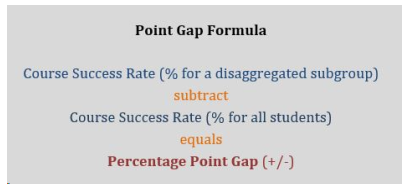
A significant equity gap exists when a subgroup’s success rate is at least 3 percentage points lower than the comparison group.
| The Impact of the Point Gap Formula 1. It makes inequities visible through data, not assumption. 2. It highlights which groups are experiencing disproportionate impact. 3. It provides a quantifiable starting point for designing equity-minded interventions at the course, program, and institutional levels. |
ORGANIZATIONAL LEARNING
Organizational learning provides the foundational framework for reframing equity gaps as institutional issues, rather than student-centered deficiencies. This perspective is crucial for shifting the narrative away from blaming students and toward transforming the structures, practices, and mental models within an institution that perpetuate inequitable outcomes. As renowned systems theorist Dr. Peter Senge explains, “Organizational learning challenges existing mental models that can be the root of institutional problems.”
In the context of equity work, those “mental models” include deficit-based assumptions about student ability, preparedness, and motivation. myPATH adopts organizational learning as its guiding framework precisely because it invites collective reflection and action. By bringing together teaching faculty, counseling faculty, library faculty, and PASS Mentors, myPATH fosters a multi-perspective, collaborative approach to understanding and addressing course-level equity gaps.
This model creates space for cross-functional dialogue where practitioners examine instructional practices, curriculum design, and student support systems through a shared equity lens. Further grounding this framework, Olivier Serrat in A Primer on Organizational Learning, defines organizational learning as “The ability of an organization to gain insight and understanding from experience through experimentation, observation, analysis, and a willingness to examine successes and failures.”
| Olivier Serrat’s Two Core Principles of Organizational Learning Relevant to Student Equity 1. Organizations learn through individuals who act as agents for them. Faculty and staff become the conduits for institutional transformation by reflecting on their own practice and adapting in response to evidence. 2. Individual learning is facilitated or constrained by the organization’s learning system. This highlights the importance of institutional culture, leadership support, and shared norms in either enabling or limiting meaningful change. |
In essence, myPATH leverages organizational learning to empower individual educators as change agents within a supportive learning community ensuring that the work of equity is not isolated but embedded in the collective growth of the institution.
DEFICIT-MINDED AND EQUITY-MINDED COGNITIVE FRAMEWORKS
Historically, many traditional equity plans have focused on expanding and integrating student support services, college readiness programs, and intervention models. While well-intentioned, this approach often locates the cause of educational disparities within the students themselves, attributing gaps in achievement to characteristics such as motivation, preparation, or socioeconomic background. This mode of thinking reflects what is known as a deficit-minded cognitive framework. According to equity scholars, this framework “Posits that students who fail in school do so because of alleged internal deficits (such as cognitive and/or motivational limitations) or shortcomings socially linked to the student.”
| Deficit-Minded Cognitive Framework and Students “They’re not motivated enough.” “They don’t ask for help.” “They work too many hours.” “They’re just not college-ready.” |
While students certainly hold some responsibility for their educational outcomes, the deficit-minded approach places all responsibility on the student, ignoring how institutional culture, policies, and instructional practices may be contributing to inequity. Organizational learning, as implemented in myPATH, offers an essential paradigm shift by encouraging institutions to adopt an equity-minded cognitive framework. This approach reframes equity as an institutional responsibility and places agency for change in the hands of educators and campus leaders. The key difference between the two approaches lies in how they frame the causes of inequitable outcomes.
Table 2: Equity-Minded vs. Deficit-Minded Frameworks
| Dimension | Equity-Minded Framework | Deficit-Minded Framework |
|---|---|---|
| Definition | A perspective that recognizes systemic inequities and holds institutions accountable for improving student outcomes | A perspective that attributes student outcomes to individual shortcomings (skills, motivation, background) |
| Core Assumption | Inequities are produced by institutional practices, policies, and structures | Inequities are caused by student deficiencies |
| View of Students | Students are capable and bring assets; they are underserved by systems | Students lack preparation, ability, or cultural capital |
| Responsibility for Outcomes | Shared by faculty, staff, and the institution | Placed primarily on students |
| Framing of Equity Gaps | “Equity gaps reflect systemic barriers that must be addressed” | “Some students perform worse because they are underprepared” |
| Use of Data | Disaggregated to identify inequities and guide institutional change | Used to highlight achievement differences without questioning causes |
| Language Examples | “Disproportionately impacted students”“Institutional barriers”“Equity gaps”“Equity-minded practice” | “At-risk students”“Underprepared students”“Remedial needs”“Low-performing students” |
| Approach to Solutions | Redesign systems, pedagogy, and policies to support student success | Provide remediation or interventions aimed at “fixing” students |
| Orientation to Race & Inequality | Acknowledges systemic racism and structural inequities | Often ignores or minimizes structural factors (“color-evasive”) |
| Goal | Achieve equitable outcomes through systemic change | Improve student performance without changing systems |
As you can read from the table above, equity-minded and deficit-minded approaches differ fundamentally in how they interpret the causes of educational inequities and where they place responsibility for change. A deficit-minded perspective attributes student underperformance to internal or social shortcomings such as lack of motivation, poor preparation, or personal limitations. This approach places the burden entirely on the student to improve. In contrast, an equity-minded approach recognizes that institutional structures, teaching practices, and implicit biases often create or perpetuate inequities. Rather than asking what’s wrong with the student, equity-minded educators ask what we can change about our systems, practices, or assumptions to support all students in achieving success.
EQUITY LANGUAGE
Closely connected to equity-minded cognitive inquiry is the intentional use of equity-minded language that clearly identifies and frames educational gaps within their proper institutional and systemic context. Failing to use such language can unintentionally undermine dialogue about equity or dilute institutional efforts aimed at transformative change. This point is powerfully articulated by Dr. Robin J. DiAngelo in White Fragility, where she stresses that “Inequity can occur simply through homogeneity; if I am not aware of the barriers you face, then I won’t see them, much less be motivated to remove them.”
By using precise and equity-minded language, educators and institutional leaders can more accurately name inequities, identify their root causes, and design targeted solutions. It allows agents of change to clearly articulate what needs to be accomplished.
Table 3: Equity-Minded Language in Practice with a Race-Conscious Framing
| Focus Area | Race-Evasive / Deficit Framing | Race-Conscious Language |
|---|---|---|
| Naming Outcomes | “Some students are not succeeding in this course.” | “Black and Latinx students are experiencing disproportionately lower pass rates in this course compared to white and Asian students.” |
| Framing the Problem | “Students are underprepared for college-level work.” | “Our course design and placement practices may be disproportionately disadvantaging Black and Latinx students.” |
| Identifying Equity Gaps | “There is an achievement gap.” | “There is a persistent racial equity gap, with Black students completing this program at significantly lower rates than their peers.” |
| Root Causes | “Students are not using available resources.” | “Support services may not be culturally responsive or accessible in ways that effectively serve Black and Latinx students.” |
| Responsibility & Accountability | “Students need to take more responsibility for their success.” | “We must examine how our institutional practices and policies contribute to racial inequities in student outcomes.” |
| Designing Solutions | “We should offer more support.” | “We will implement targeted, culturally responsive supports and redesign high-impact courses to better serve Black and Latinx students.” |
| Approach to Equity | “All students should be treated the same.” | “Race-conscious strategies are necessary to address systemic inequities and close racial equity gaps.” |
In essence, specific language drives specific action and equity-minded language ensures that such action is grounded in a commitment to justice, institutional responsibility, and sustained systemic change.
Again, ultimately language shapes action and to drive meaningful change, equity work must begin with clear, precise, and intentional communication that frames inequities as institutional challenges requiring collective responsibility.
Table 4: Equity-Minded vs. Diversity vs. Deficit-Minded Language
| Framework | Definition | Primary Focus | Example Terms |
|---|---|---|---|
| Equity-Minded Language | An approach that recognizes systemic inequities and centers institutional responsibility to ensure fair outcomes for all students | Eliminating equity gaps by addressing structural barriers and redesigning systems | Disproportionately impacted students Latinx Latina(o) Hispanic African American/Black Asian/Asian America/Pacific Islander Native American Equity gaps Institutional barriers Equity-minded teaching Culturally responsive practices |
| Diversity Language | An approach that emphasizes the presence and representation of different demographic groups within an institution | Inclusion, representation, and visibility of diverse populations | Underrepresented students Underserved Diverse learners Multicultural Students of color Diversity |
| Deficit-Minded Language | An approach that attributes student challenges or outcomes to individual shortcomings rather than systemic factors | Identifying and “fixing” perceived student deficiencies | At-risk students Non-traditional Underprepared students Remedial needs Low-performing students Underprivileged |
WHY RACE MATTERS
Take a moment to revisit the table immediately above. As you review language and intentionality, you likely noticed that equity-minded language in most cases is race-specific. So why does race hold such a central position in equity discourse? Simply put, in the California Community College system, and across institutions of higher education both statewide and nationally, the equity gaps revealed by disaggregated data are not race-neutral. Time and time again, Black, Latinx, Native American, and Pacific Islander students are disproportionately impacted in measures of access, retention, completion, and transfer. This reality is confirmed by a landmark national study conducted by the American Council on Education (ACE) titled Race and Ethnicity in Higher Education: A Status Report The study concludes that “Race and ethnicity still matter in American higher education.”
| Race and Ethnicity in Higher Education: A Status Report Key Findings 1. Persistent racial disparities in academic preparation, college enrollment, and degree attainment. 2. Community colleges, which serve the highest proportion of racially minoritized students, often have the fewest resources and least structured support systems to address these disparities. 3. And that despite efforts to broaden access, systemic barriers continue to limit opportunity and upward mobility for students of color. |
Therefore, to avoid naming race in equity efforts is to overlook one of the most significant, systemic factors driving educational inequity. Given what disaggregated data has revealed about persistent student equity gaps in higher education, race must be an integral component of both equity dialogue and action. Without explicitly addressing race, institutions risk masking the very disparities they aim to correct. As DiAngelo warns, “Not naming the groups that face barriers only serves those who already have access; the assumption is that the access enjoyed by the controlling group is universal.”
Historically, the primary barrier to higher education for minoritized students was access itself. Today, while access has improved, it is no longer the only challenge these students face. It is now also academic completion. Consequently, the current imperative is ensuring that once students, particularly historically minoritized students, enter college, they are retained, supported, and guided to completion of their academic and career goals. In short, access is not enough. Institutions of higher education must adopt intentional frameworks that address student success, persistence, and degree attainment with an equity lens focused on race. This point is reinforced by Lorelle Espinosa, Vice President of Research at the American Council on Education (ACE), who explains that “As a higher education community, we ought to be very concerned about what are, in many cases, longstanding trends that show differing levels of postsecondary access and success across racial and ethnic groups.”
To close these gaps, equity work must move beyond generalized solutions and engage in race-conscious strategies that confront systemic barriers and promote educational justice for students experiencing equity gaps.
WHY RACE AND NOT INCOME?
A common belief among many educators and practitioners is that income, not race, is the primary factor driving equity gaps in higher education. While it is true that race and class are often interlinked, focusing exclusively on income ignores the historical, structural, and cultural forces that have made race a defining determinant of educational access and success in the United States. As Walter Allen, Chantal Jones, and Channel McLewis argue in The Problematic Nature of Racial and Ethnic Categories in Higher Education, “Race and ethnicity operate as tools to distinguish between who is ‘the norm’ and who is ‘the other’—a fundamental concept that has profoundly shaped, and continues to shape, the history, polity, economic structure, and culture of the United States.”
Table 5: Historical, Structural, and Cultural Forces Making Race a Determinant of Student Equity
| Dimension | Key Forces | Shape Inequities | Examples in Education |
|---|---|---|---|
| Historical Forces | Segregation, exclusionary policies, and unequal access to education over time | Historical racism established unequal starting points in access to schooling, resources, and college opportunity that persist across generations | Segregated K–12 systems, exclusion of Black and Latinx students from institutions, unequal funding patterns rooted in past policies |
| Structural Forces | Institutional policies, systemic racism, and resource distribution | Ongoing inequities are reproduced through policies, practices, and structures that advantage some groups while disadvantaging others | Inequitable school funding, biased placement systems, tracking, differential access to advanced coursework, disparities in college access and completion |
| Cultural Forces | Dominant norms, deficit ideologies, and race-evasive practices | Cultural narratives shape expectations, interactions, and decision-making, often reinforcing inequities and obscuring systemic causes | Deficit language about minoritized students, “colorblind” approaches that ignore race, lack of culturally responsive pedagogy, marginalization of students’ lived experiences |
In short, while class is an important factor, race carries a distinct and enduring legacy of exclusion, marginalization, and unequal opportunity in American higher education. Equity work that fails to explicitly address race risks being incomplete and ineffective, as it overlooks the very systems and narratives that continue to shape disparities in student success. Focusing solely on income removes race from the conversation and with it the historical and social context necessary to understand educational inequities in full.
| C.D. Ching, Why Race? Understanding the Importance of Foregrounding Race and Ethnicity in Achieving Equity on College Campuses “Race is visible; income is a status that is not immediately apparent to the eye.” “Racial and ethnic minorities have been legally prohibited from attending predominantly white colleges and universities. No such legal barrier has ever existed for low-income students.” “Race impacts the development of social capital crucial for educational opportunity.” “Not focusing on race makes it more difficult to understand fully the impact of race on educational opportunity.” |
IN CLOSING
The overview provided in this module was designed to help you establish a clear understanding of what equity means and why equity work must be race-specific. You were also introduced to the power of language in shaping how institutions frame and address educational inequities reinforcing the idea that intentional, equity-minded language drives intentional, equity-minded action.
As we move forward, our next topic, Building an Equity Lens, will deepen this foundation by exploring key concepts such as positionality, Critical Race Theory, and intersectionality. These frameworks will help illuminate the lived experiences of historically minoritized students in higher education and guide us in identifying how we, as educators and practitioners, can amplify their voices and ensure that equity work is grounded in student-centered transformation.