What is myPATH?
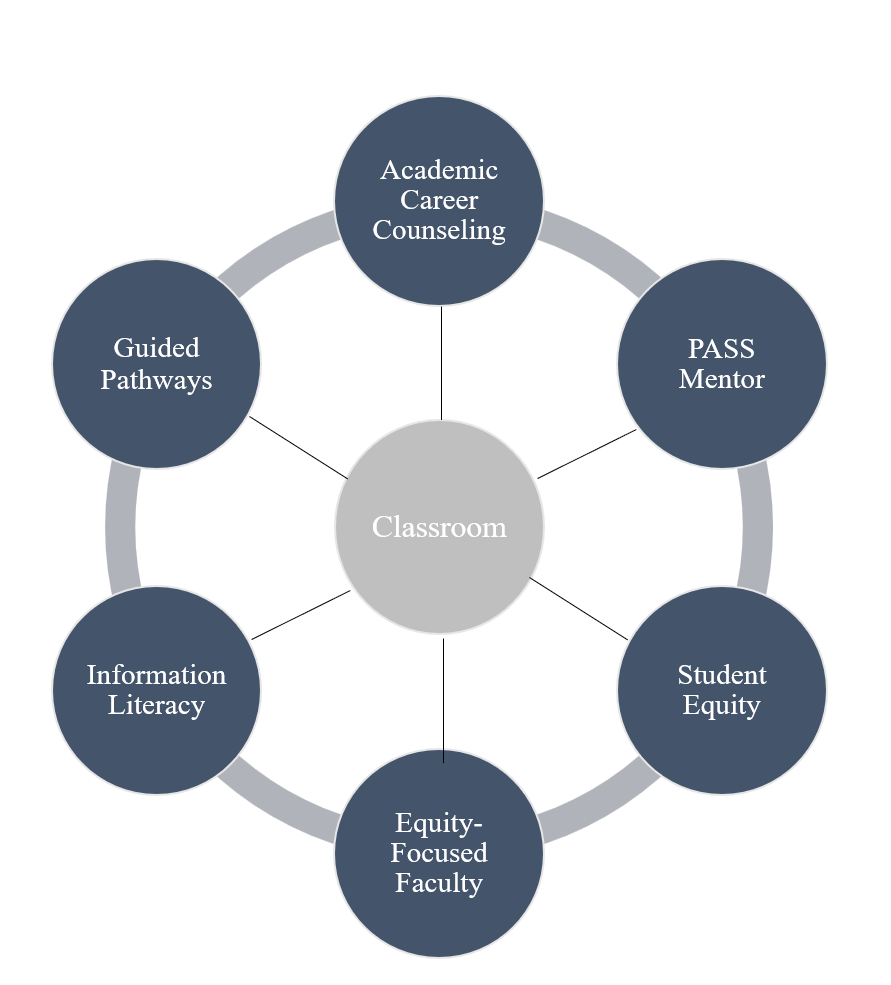
myPATH and the myPATH Equity Institute were developed by Jason R. Suárez, Professor of History and Student Equity and Achievement Faculty Coordinator, to address equity gaps through an organizational learning framework. This framework invites faculty to critically examine how their teaching practices, perceptions of student learning, assignment design, and content delivery may contribute to inequities. It fosters institution-wide dialogue aimed at developing and implementing equitable practices, using disaggregated student completion data analyzed through an equity-minded, cognitive lens. myPATH also aligns with the principles of Guided Pathways and the Vision 2030 Goals, Outcomes, and Metrics. By fostering pedagogical partnerships, it brings together counseling faculty, teaching faculty, library faculty, and PASS Mentors within the classroom to collaboratively support equitable educational outcomes.
Image 1: The myPATH Pedagogical Partnership Model
Why does myPATH focus on this approach? Faculty agency and the reality that students spend the majority of their time each semester in the classroom. In addition, equity gaps are typically assessed through retention and success rates, both of which are directly tied to course completion. This makes the classroom the most critical setting for advancing equity and faculty as central agents of change.
By centering on faculty agency, myPATH leverages the power of instructional practice to close equity gaps and deliver a more inclusive, programmatic experience across all myPATH-designated courses. This model creates a consistent, equity-focused learning environment.
| Equity-Focused Classroom Characteristics | MyPATH Application |
|---|---|
| Equitable Curriculum Design | The intentional development of course content and structure that reflects diverse perspectives and accommodates varied learning needs to promote fairness and inclusion in student learning. |
| Collaborative Support Networks | Integrated systems of support that connect teaching faculty, counseling faculty, library faculty, and PASS Mentors to provide coordinated and holistic assistance to students. |
| Assignment Scaffolding | The structured sequencing of assignments and learning activities that build student skills progressively, aligned with Guided Pathways to support deeper learning and completion. |
| Culturally Responsive Engagement | Ongoing instructional practices that recognize and value students’ cultural backgrounds while providing meaningful feedback to enhance learning and connection. |
| Access to Resources | The availability and timely delivery of academic and personal support services that students can utilize when they need them most to stay on track. |
| Data-Informed Interventions | The use of disaggregated student data to design targeted strategies that improve outcomes, particularly for historically underrepresented student groups. |
In addition, myPATH supports faculty in conducting comprehensive equity audits of instructional objectives, course outlines of record, and syllabi to ensure alignment with equitable design principles and inclusive teaching practices. These audits help faculty intentionally embed equity-minded strategies into the foundation of their courses. Also, myPATH provides guidance on building and sustaining pedagogical partnerships among content faculty, counseling faculty, library faculty, and peer mentors. These collaborative relationships are essential to creating a cohesive, student-centered learning experience that extends beyond disciplinary silos.
myPATH advances its mission by integrating organizational learning with four core pillars that shape an equitable learning environment.
Table: The Four Pillars of myPATH’s Equity and Student Support Framework
| Pillar | Outcome |
|---|---|
| Intersectionality | Recognizing and addressing the diverse identities and lived experiences of students. |
| Social and Emotional Engagement | Fostering connection, belonging, and psychological safety in the classroom. |
| Support System Cultivation | Strengthening the academic and personal networks that support student success. |
| Equitable Instructional Design | Embedding inclusive, data-informed teaching strategies into course structures. |
Together, these pillars serve as the foundation for transforming instructional practice and promoting systemic equity across the educational experience.
Faculty engage in equitable instructional design and classroom practices by first completing the myPATH Equity Institute. The content of the Institute serves as a foundational professional learning experience that equips faculty ideas and tools necessary to foster inclusive, student-centered learning environments. The institute is also designed to build a shared understanding of equity amongst myPATH faculty and to align their practices with broader institutional goals.
Table 3: Equity-Focused Faculty Development Framework
| Category | Content / Focus |
|---|---|
| Institutional Context & Equity Mission | Contextualize myPATH’s mission by examining how it addresses the systemic inequities historically marginalized students experience in higher education. |
| Policy Alignment & Systems Thinking | Align classroom practices with statewide initiatives by exploring the Vision for Success Goals and Vision 2030 Goals, Outcomes, and Metrics, and identifying how myPATH operationalizes these objectives in course design and instruction. |
| Equity Foundations & Data Literacy | Define equity and articulate the importance of institution-wide analysis of disaggregated data to reveal and address equity gaps. |
| Equity Language & Discourse | Emphasize the significance of race and equity language in educational discourse, and why using precise, inclusive terminology matters when confronting inequities. |
| Critical Theoretical Frameworks | Introduce frameworks such as positionality, Critical Race Theory (CRT), and intersectionality to help faculty develop a critical equity lens in both pedagogy and student engagement. |
| Equitable Pedagogy & Instructional Design | Define and explore equitable instructional design and anti-racist pedagogy, highlighting practical applications for course content, assessment, and interaction. |
| Social-Emotional Engagement & Belonging | Examine the role of social-emotional engagement in creating psychologically safe, supportive, and affirming classroom environments that foster student belonging and persistence. |
| Student Support Systems & Holistic Success | Understand how cultivating support systems—both within and beyond the classroom—enhances equitable student outcomes by connecting learners with academic, emotional, and community-based resources. |
Through this structured and intentional framework, the myPATH Equity Institute prepares faculty to become equity-minded practitioners and co-creators of transformational learning experiences for historically minoritized students.
Upon successful completion of the myPATH Equity Institute, faculty members’ courses are officially designated as myPATH in the college’s Schedule of Classes. These designations not only recognize the faculty’s commitment to equitable instructional practices but also signal to students the added value and support embedded in these sections. Students are informed that enrolling in myPATH-designated courses offers intentional, equity-centered teaching, collaborative support structures, and increased access to academic resources. Below is the data indicating the total number of course sections designated as myPATH during the 2023–2024 academic year:
- Fall 2023 – 50 Sections with 6 Academic Divisions
- Behavioral & Social Sciences
- Business
- Fine Arts
- Humanities
- Health Sciences and Athletics
- Library and Learning Resources
- Spring 2024 – 61 Sections with 5 Academic Divisions
- Behavioral & Social Sciences
- Business
- Fine Arts
- Humanities
- Health Sciences and Athletics
A Brief History of myPATH
myPATH traces its origins back to 2016, when Dr. Gloria Miranda, then Dean of the Division of Behavioral and Social Sciences, recognized the urgent need to address persistent equity gaps within her division. In response, she initiated a division-wide effort focused on improving student outcomes through an equity lens. This effort culminated in a proposal entitled Student Equity Reenvisioned: Bridging the Equity Gap for African-American and Latino Students in the Behavioral and Social Sciences which laid the groundwork for what would eventually become the myPATH initiative. Building on the foundation of the original proposal, a revised and expanded version was submitted in 2018 to the newly appointed Dean of Behavioral and Social Sciences, Dr. Christina Gold. This updated proposal retained the core vision of addressing equity gaps through faculty-led change but incorporated emerging research, faculty feedback, and institutional priorities to strengthen its scope and scalability. Under Dr. Gold’s leadership, the proposal gained renewed momentum, leading to broader faculty engagement and laying the groundwork for the formal launch of myPATH as a division-wide equity initiative with the potential for college-wide adoption. This proposal-myPATH-laid the foundation for the current model, which seamlessly integrates student equity, Guided Pathways, and the Vision 2030 Goals into the classroom through intentional pedagogical partnerships. By aligning institutional initiatives with instructional practice, myPATH transforms equity from a theoretical commitment into a lived, collaborative experience within the learning environment.
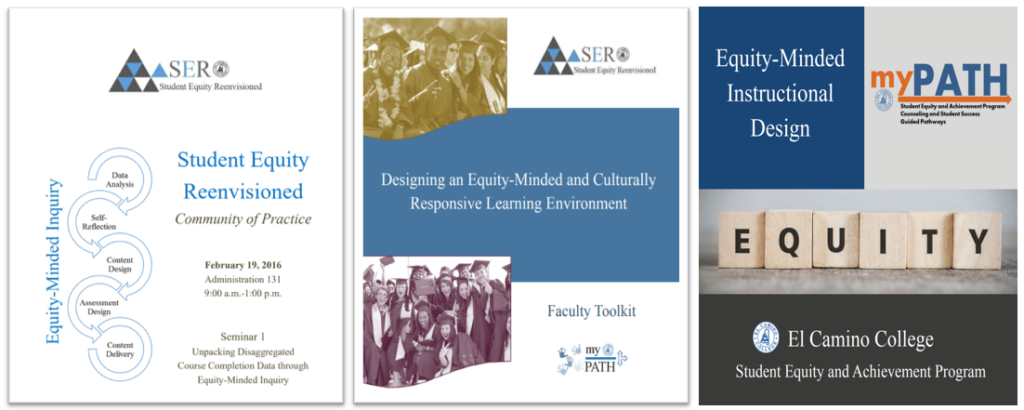
From the original proposal submitted to Dr. Miranda in 2016 emerged El Camino College’s first Faculty Equity Toolkit, Student Equity Reenvisioned: An Equity Inquiry Community of Practice. This toolkit provided practical strategies, reflective questions, and evidence-based approaches aimed at helping instructors critically examine their pedagogical choices, curriculum design, and classroom climate. It marked a significant step toward institutionalizing equity at the course level and became a cornerstone in the development of what would later evolve into the myPATH initiative. This toolkit was later modified and expanded in 2019 (Designing an Equity-Minded and Culturally Responsive Learning Environment) and in 2020 (Equity-Minded Instructional Design).
Since its inception in 2016, myPATH leadership has remained deeply committed to advancing student equity at El Camino College. In recent years, much of myPATH’s equity-focused work has been made possible through the collaboration and support of key campus leaders, including Dr. Jeff Stephenson (Vice President of Student Services), Nayeli Oliva (Director of the Student Equity and Achievement Program), Dr. Christina Gold (Dean of Behavioral and Social Sciences), Dipte Patel (Dean of Counseling and Student Success), and Russell Serr (Dean of Health Sciences and Athletics)These collective efforts have taken shape through:
- Equity-focuses workshops workshops and learning communities.
- Course and degree development, inclusing Social Science 101, Social Science 103, and the Social Justice ADT.
- Creation of non-credit equity curriculum such as Social Science 104 and Social Science 105.
- Three new collaborative initiatives to be launched in Fall 2024 (see below for details).
In addition, myPATH’s original Faculty Equity Toolkit has been transformed into a self-paced online training making equity professional development more accessible, flexible, and sustainable for faculty across the institution.

myPATH/SEA Proposals/Initiatives to be Launched Spring 2025
Equity Transfer Academy
The Equity Transfer Academy (ETA) is a strategic initiative aimed at increasing retention and transfer rates among student populations experiencing equity gaps at El Camino College (ECC). Designed as a comprehensive support system, ETA specifically serves historically minoritized students who aspire to complete a bachelor’s degree following their community college education.
The pilot phase of the initiative will center on the transfer and retention success of African American/Black students, in alignment with ECC’s Student Equity Plan. By addressing systemic barriers and providing targeted resources, ETA seeks to ensure that students not only persist through their academic journey at ECC, but are also well-prepared and supported in transferring to four-year institutions.
Historically, El Camino College (ECC) has served as a vital access point for students seeking to complete a Bachelor of Arts or Science degree at a four-year institution. While ECC has developed transfer pathways and student support services aimed at fostering student success, historically minoritized students—particularly African American/Black students—continue to encounter systemic barriers that hinder their ability to complete this academic journey. Institutional data reflect this challenge:
- In the 2022–2023 academic year, 144 African American/Black students transferred from ECC to the California State University (CSU) system.
- In 2023–2024, that number declined to 98, representing a nearly 32% drop in successful CSU transfers among this student population.
Extensive research on the community college system highlights multiple barriers affecting the transfer success of historically minoritized students. These include:
- Limited access to academic advising and transfer support services.
- Insufficient understanding of the complex transfer process.
- Financial constraints and personal responsibilities.
- Broader institutional and structural factors, such as:
- Historical legacies of inclusion or exclusion.
- Low compositional diversity.
- Unsupportive psychological and behavioral climates.
- Inadequate structural diversity
A recent national study on African American/Black students in community colleges concluded that “Black community college students experience the lowest graduation rates when compared to their peers of other races and ethnicities. The gap between Black and white graduation rates more than doubled from four percentage points in 2007 to 11 percentage points in 2020, the latest year data is available.” These findings underscore the urgent need for equity-focused, research-informed initiatives like the Equity Transfer Academy (ETA) to dismantle these barriers and improve transfer outcomes for African American/Black students.
Fortunately, a growing body of research has identified key factors that positively influence the retention and success of African American/Black college students. One such factor is the integration of culturally responsive curriculum—course content that reflects both the current and historical experiences of individuals from communities of color. Additionally, programming and initiatives that actively support the recruitment, persistence, and graduation of students of color have been shown to improve educational outcomes.
Another critical factor emphasized in the literature is the need to provide intentional cultural spaces for historically minoritized students. These are environments where students can feel psychologically safe, seen, and valued. As one report states, “The ability for students to feel a sense of safety and belonging, which is foundational to student success, begins with creating intentional spaces where they are welcomed and affirmed.” Such spaces not only foster belonging and affirmation, but also contribute to a campus climate that supports identity development, emotional well-being, and engagement—all of which are essential to academic persistence and achievement.
Drawing on insights from research-based studies, the Equity Transfer Academy (ETA) is designed to directly address the barriers and challenges impacting the transfer success of African American/Black students at El Camino College (ECC). The initiative will bridge four key areas of student support:
- Structured academic guidance.
- Targeted academic support services.
- Accessible resources tailored to transfer preparation.
- Culturally responsive mentorship.
Together, these elements form a comprehensive framework that supports students throughout their transfer journey.
A central component of ETA’s approach is the integration of Student Equity and Achievement (SEA) equity centers. These centers will serve not only as safe, affirming spaces but also as hubs for delivering resources, services, and community-based programming. The inclusion of equity centers aligns with research findings which underscore their transformative impact on student learning environments. As one study notes, “These centers make a powerful difference in student learning because they foster an environment that promotes leadership development, a sense of community, cultural identity, and a sense of mattering—all components necessary for engagement in the learning process.”
By grounding the initiative in these intentional spaces, ETA aims to cultivate the sense of belonging, identity, and empowerment that is critical for the retention and success of historically minoritized students. Ultimately, ETA will establish the necessary infrastructure to guide students through the often complex and opaque transfer process, resulting in increased transfer rates and more equitable access to higher education. By implementing a comprehensive support system tailored specifically to the needs of transfer-bound students, the Academy will empower a diverse student population to realize their academic and career aspirations.
ETA Objectives for African American/Black Students
- Provide a holistic support system that includes academic advising, targeted workshops, and readily available transfer-related resources.
- Equip students with essential academic skills and knowledge needed for transfer readiness and long-term academic success.
- Create a culturally affirming and safe space where students have access to social capital, mentorship opportunities, community resources, and support for mental health and well-being.
To successfully launch the ETA pilot, collaborative leadership and coordination will be essential. The initial implementation phase will bring together a cross-functional coalition of departments and initiatives, including:
- Transfer Center
- Student Equity and Achievement (SEA) Program
- Behavioral and Social Sciences Division
- Umoja/Project Success
- Men of Color Action Network (MOCAN)
- Black Student Success Center
- SEA Equity Centers
- myPATH Initiative
This strategic partnership will ensure that ETA’s framework is deeply embedded in institutional systems and that participating students receive comprehensive, culturally responsive support throughout their educational journey.
myPATH Institutional Alignment Tables
Table 1: myPATH Vision 2030 Alignment
| Goal | Outcomes and Metrics | myPATH |
|---|---|---|
| Goal 1: Equity in Success: Ensure the academic and career success of all Californians who are current and prospective California community college students. | Outcome 1: Completion – Increase with equity the number of California community college students who complete a meaningful educational outcome. Outcome 2: Baccalaureate Attainment – Increase, with equity, the number of California community college students who earn an Associate Degree for Transfer / transfer to California State University (CSU) or University of California (UC) / transfer to non-profit private/independent four-year institutions. | myPATH Designated Classes *Equity-Minded Faculty *Equitized Curriculum *Career/Major Assignment Embedded Counselor *Academic Planning *Career Exploration *Student Support/Services Exploration PASS Mentor *Academic and Peer Mentorship |
| Goal 2: Equity in Access: Broaden the opportunities for all Californians to participate in higher education by starting or continuing their higher education at a California community college. | Outcome 4: Student Participation – Increase, with equity the number of students attending a California community college, with particular emphasis on the number of underserved Californians. | myPATH through the Social Science Pathway has worked with Outreach and The Promise. This will be revisited, and Marketing will also be contacted. |
| Goal 3: Equity in Support: Partner with other systems, agencies, institutions and community-based organizations to provide students the academic, financial and social supports necessary to thrive by taking education opportunities and the accompanying support to Californians. | Outcome 5: Maximizing Financial Aid – Increase with equity the number of California community college students receiving state and federal aid for which they are eligible to better support their educational journey. Outcome 6: Reduce Time to Completion – Decrease with equity the number of units in excess of 60 units for the Associate Degree for Transfer (ADT). | myPATH Designated Classes *Equity-Minded Faculty *Equitized Curriculum *Career/Major Assignment Embedded Counselor *Academic Planning *Career Exploration *Student Support/Services Exploration |
Table 2: myPATH SEA Metric Alignment
| Metric | (Student Services) Activities that Support the Metric | (AC) Activities that Support the Metric |
|---|---|---|
| Access: Community Alignment. | Intentional class scheduling of learning communities and myPATH classes based on student needs and demand | |
| Retention: Fall to Spring. | Pedagogical Partnerships: Academic/Career Counselors *Academic planning *Career exploration *Student Support/Services Exploration *Career/Major Portfolio *Cultural Center Support *SEA Achievement Academies | Pedagogical Partnerships: myPATH Designated Courses *PASS Mentor Program *Equitized Curriculum *Equity-minded faculty *Affinity Center Support *Information literacy *Learning communities *Career/Major Portfolio *SEA Achievement Academies |
| Transfer to a four-year institution. | Pedagogical Partnerships: Academic/Career Counselors *Academic planning *Career exploration *Student Support/Services Exploration *Career/Major Portfolio *Affinity Center Support *SEA Achievement Academies | Pedagogical Partnerships: myPATH Designated Courses *PASS Mentor Program *Equitized Curriculum *Equity-minded faculty *Affinity Center Support *Information literacy *Learning communities *Career/Major Portfolio *SEA Achievement Academies |
| Completion of transfer level math and English. | Learning communities that link English and math courses to BSS courses – reinforce content, retention success. | |
| Earned credit certificate over 18 units, associate degree, CCC bachelor’s degree. | Ensure alignment of associate degree requirements with student goals – transfer and/or workforce preparation. |
Table 4: myPATH Guided Pathways Alignment
| Pathway Pillar | myPATH Activities that Support the Pillars |
|---|---|
| Clarifying the path for students. | Pedagogical Partnerships: Academic/Career Counselors Academic planning Career exploration Student Support/Services Exploration Career/Major Portfolio |
| Helping students get on a path. | Pedagogical Partnerships: Academic/Career Counselors Academic planning Career exploration Student Support/Services Exploration Career/Major Portfolio SEA Achievement Academies |
| Helping students stay on their path. | Pedagogical Partnerships: myPATH Designated Courses PASS Mentor Program Equitized Curriculum Equity-minded faculty Affinity Center Support Information literacy Learning communities Career/Major Portfolio SEA Achievement Academies |
| Ensuring students are learning. | Pedagogical Partnerships: myPATH Designated Courses PASS Mentor Program Equitized Curriculum Equity-minded faculty Affinity Center Support Information literacy▪ Learning communities |