
LEARNING OBJECTIVES
- Define and explain what equitable instructional design is.
- Define and explain what role social-emotional engagement has in creating an equitable learning environment.
- Define and explain how support system cultivation can contribute to creating an equitable learning environment.
WHAT IS LEARNING?
Before we explore instructional design and its role in fostering equity-minded teaching practices, it is essential to first ground our discussion in a fundamental question: What is learning? Understanding this is crucial because, as scholars have noted, “any set of learning principles is predicated on a definition of learning.” In other words, how we design instruction and assess learning outcomes depends on how we conceptualize learning itself.
To guide your reflection, consider the following insights from Susan A. Ambrose’s influential work, How Learning Works: Seven Research-Based Principles for Smart Teaching.
| “Learning is a process, not a product. However, because this process takes place in the mind, we can only infer that it has occurred from students’ products or performances.” “Learning involves change in knowledge, beliefs, behaviors, or attitudes. This change unfolds over time; it is not fleeting but rather has a lasting impact on how students think and act.” “Learning is not something done to students, but rather something students themselves do. It is the direct result of how students interpret and respond to their experiences—conscious and unconscious, past and present.” |
These statements invite us to think critically about the nature of learning, what supports or hinders it, and how our instructional choices can be shaped to support all students equitably.
To summarize Ambrose’s ideas, one might define learning as “a change in knowledge attributable to experience.” For this transformation to occur, the learner must be an active participant in the process. This understanding underscores the longstanding emphasis on student-centered learning environments, where students’ individual beliefs, lived experiences, and cultural backgrounds serve as the foundation for constructing new knowledge.
Student-centered environments are designed to enrich and extend learning by integrating diverse perspectives, resources, and representations. They recognize the importance of students’ prior knowledge and everyday experiences as vital to meaning-making. In this way, student-centered pedagogy not only supports academic success—it also serves as a natural bridge to equitable learning environments.
Table 1: Core Principles of Student-Centered Learning in Higher Education
| Principle | Definition / Main Idea | What It Looks Like in Practice |
|---|---|---|
| Active Learning | Learning is constructed through active engagement rather than passive reception of information | Discussions, problem-based learning, group work, case studies instead of lecture-only formats |
| Student Agency & Ownership | Students take responsibility for their learning, including setting goals and making choices | Choice in assignments, student-led discussions, self-directed projects |
| Personalization & Differentiation | Instruction is adapted to meet diverse student needs, backgrounds, and learning styles | Flexible pacing, varied assessments, multiple ways to demonstrate learning |
| Constructivist Learning | Knowledge is built through experience, reflection, and interaction with content and others | Experiential learning, inquiry-based learning, real-world problem solving |
| Collaborative Learning | Learning is social and enhanced through interaction with peers | Peer instruction, group projects, collaborative problem-solving |
| Formative Assessment & Feedback | Ongoing assessment supports learning rather than just evaluating it | Low-stakes quizzes, feedback loops, revision opportunities |
| Relevance & Real-World Connection | Learning is meaningful when connected to students’ lives, goals, and future careers | Applied projects, community-based learning, career-connected assignments |
| Instructor as Facilitator | The instructor guides and supports learning rather than acting solely as the source of knowledge | Coaching, mentoring, scaffolding rather than direct instruction only |
| Inclusive & Holistic Development | Focus on the whole student, including cognitive, social, and emotional development | Culturally responsive teaching, supportive learning environments |
However, creating such environments requires more than pedagogical strategies; it necessitates a deep understanding of student identity, cultural wealth, and funds of knowledge. That’s why the myPATH Equity Institute emphasizes that one of the most critical steps in creating an equitable classroom is simply this: know who your students are. When educators intentionally learn about their students, their stories, strengths, and struggles they are better positioned to design inclusive learning environments that affirm identities and foster equity. Only then can the transition from a generic learning space to an intentionally equitable learning environment begin in earnest.
DESIGNING LEARNING ENVIRONMENTS
Instructional Design (ID) is an interdisciplinary field that draws upon research and theory from various disciplines such as cognitive psychology, communication studies, and learning sciences. The goal behind this process is to improve how instruction is developed, delivered, and evaluated. It is best defined as “the systematic and reflective process of translating principles of learning and instruction into plans for instructional materials, activities, information resources, and evaluation tools.”
There are multiple instructional design models in use today, each selected based on the specific learning context, goals, and needs of the learner population. Regardless of the model chosen, the ultimate purpose of instructional design is to uphold and implement key principles of learning that ensure instruction is both effective and inclusive. Thus a critical component of any instructional design plan is understanding the target audience, specifically, identifying who the learners are and anticipating what they are capable of doing and achieving. Effective instructional design requires this insight in order to create meaningful and accessible learning experiences.
Table 2: Key Instructional Design Models and Their Core Principles
| Instructional Design Model | Key Principles | What It Emphasizes in Practice |
|---|---|---|
| ADDIE Model (Analyze, Design, Develop, Implement, Evaluate) | Systematic, iterative process; alignment of objectives, instruction, and assessment; continuous evaluation | Step-by-step course development with ongoing assessment and refinement |
| Backward Design | Begin with learning outcomes; align assessments; design instruction last | Clear focus on what students should learn, ensuring all activities and assessments support those outcomes |
| Universal Design for Learning (UDL) | Multiple means of engagement, representation, and expression; learner variability; proactive accessibility | Flexible course design (e.g., varied content formats, multiple assessment options, inclusive materials) |
| Universal Instructional Design (UID) | Anticipates diverse learner needs; removes barriers in course design; promotes usability and inclusivity | Designing courses that are accessible to the widest range of students without need for retrofitting accommodations |
| Constructivist Design Models | Learning as active, contextual, and socially constructed; student-centered environments | Inquiry-based learning, real-world problem solving, experiential activities |
| Gagné’s Nine Events of Instruction | Structured sequence aligned with cognitive learning processes (attention, guidance, practice, feedback) | Organized lessons that scaffold learning step-by-step |
| SAM (Successive Approximation Model) | Iterative, agile design; rapid prototyping; continuous feedback | Fast cycles of design, testing, and improvement rather than linear development |
| Design Thinking (Human-Centered Design) | Empathy for learners; problem-solving; ideation and prototyping; iterative testing | Designing learning experiences based on student needs, experiences, and feedback |
Two design frameworks that explicitly address learner diversity and inclusion are Universal Instructional Design (UID) and Universal Design for Learning (UDL). Both models are rooted in the recognition that learners bring varied backgrounds, needs, and strengths to the educational environment. As such, UID and UDL emphasize proactive planning to reduce barriers and ensure that all students have equitable access to learning.
UDL, grounded in cognitive neuroscience, promotes flexible curriculum design by offering multiple means of engagement, representation, and expression. It focuses on proactively designing learning goals, materials, and assessments to address the full range of learner variability.
Table 3: Key Principles of Universal Instructional Design
| Principle | Description | What It Looks Like in Academic Practice |
|---|---|---|
| Equitable Use | Instruction is designed to be accessible and useful to all students, regardless of ability or background | Course materials available in multiple formats (text, audio, video); no student is singled out for accommodations |
| Flexibility in Use | Instruction accommodates a wide range of learning preferences and abilities | Option in assignments (e.g., written paper, presentation, multimedia project) |
| Simple and Intuitive | Course design is easy to understand, regardless of students’ experience or knowledge level | Clear instructions, consistent course layout in LMS, transparent expectations |
| Perceptible Information | Information is communicated effectively to all learners | Captioned videos, readable fonts, screen-reader compatible documents |
| Tolerance for Error | Design minimizes negative consequences of mistakes and supports learning through trial and error | Opportunities for revision, low-stakes assessments, formative feedback |
| Low Physical Effort | Learning tasks do not require unnecessary physical effort | Materials accessible without excessive navigation; streamlined course structure |
| Size and Space for Approach and Use | Learning environments accommodate diverse physical and technological needs | Accessible classroom layouts; mobile-friendly course platforms |
| Community of Learners | Instruction promotes interaction and communication among students and instructors | Collaborative learning, discussion boards, peer engagement |
| Instructional Climate | The learning environment is welcoming, inclusive, and supportive | Inclusive syllabus language, culturally responsive teaching, respect for diverse perspectives |
In contrast, UID, which stems from architectural principles of universal design, centers on creating accessible instructional strategies and classroom environments. While UID emphasizes removing physical and procedural barriers, UDL takes a broader approach, addressing cognitive and learning differences from the outset..
Table 4: Key Principles of Universal Design for Learning
| Principle | Description | What It Looks Like in Academic Practice |
|---|---|---|
| Multiple Means of Engagement | Provide different ways to motivate and engage students based on their interests and needs | Choice in topics, culturally relevant content, collaborative and independent learning options |
| Multiple Means of Representation | Present information in various formats to support diverse ways of understanding | Videos, readings, visuals, audio lectures, diagrams, and interactive content |
| Multiple Means of Action & Expression | Allow students different ways to demonstrate what they know | Choice for assessments (e.g., essays, presentations, projects, multimedia submissions) |
| Options for Recruiting Interest | Connect learning to student interests and identities to increase motivation | Real-world applications, culturally responsive examples, student choice in assignments |
| Options for Sustaining Effort & Persistence | Support ongoing engagement and resilience in learning | Clear goals, scaffolding, collaborative learning, timely feedback |
| Options for Self-Regulation | Help students develop metacognitive and self-management skills | Reflection activities, goal setting, checklists, opportunities for revision |
| Options for Perception | Ensure content is accessible to all learners | Captioned videos, alt text for images, accessible documents |
| Options for Language & Symbols | Clarify vocabulary and support comprehension | Glossaries, visual supports, simplified explanations, multilingual resources |
| Options for Comprehension | Support deeper understanding and transfer of knowledge | Graphic organizers, concept maps, guided practice, real-world connections |
| Options for Physical Action | Provide flexible ways for students to interact with learning materials | Keyboard navigation, accessible tools, flexible participation formats |
| Options for Expression & Communication | Allow varied communication methods | Written, oral, visual, or digital formats for demonstrating learning |
| Options for Executive Functions | Support planning, organization, and goal-directed learning | Rubrics, timelines, scaffolding, structured assignments |
EQUITABLE INSTRUCTIONAL DESIGN
Equitable instructional design draws from the foundational principles of Instructional Design (ID), Universal Instructional Design (UID), and Universal Design for Learning (UDL), but applies them through an equity lens. This approach emphasizes the need to intentionally center the experiences and needs of student populations who have been historically marginalized within one’s institution. Its goal is to rethink, reframe, and reconstruct the curriculum to foster inclusive and just learning environments.
A key challenge in this process is recognizing that faculty often “recommend instructional activities that they themselves learned from and/or that best fit their preferred learning style.” While this may be a natural impulse, it can inadvertently center the instructor’s experience rather than the students’. Equitable instructional design calls for a shift—from instructor-centered to student-centered planning that considers diverse learning needs, backgrounds, and cultural contexts.
This design approach emphasizes the inclusion of diverse voices, narratives, and sources of knowledge, asking critical questions such as:
- How can different frameworks, traditions, and knowledge systems inform one another?
- How can multiple voices be heard and valued in the learning space?
- How do new perspectives emerge from mutual learning?
By integrating these questions into curriculum design, equitable instructional design moves beyond access to truly transform learning environments—ensuring that equity is not only acknowledged but embedded into every layer of instruction.
Table 5: How UDL and UID Advance Racial Equity in Instructional Design
| Dimension | Universal Design for Learning (UDL) | Universal Instructional Design (UID) | Racial Equity Impact |
|---|---|---|---|
| Core Approach | Centers learner variability, including cultural, racial, and linguistic diversity | Designs instruction to be accessible and inclusive from the outset | Shifts away from “one-size-fits-all” models that disproportionately disadvantage racially minoritized students |
| Access to Learning | Provides multiple ways to access content that reflect diverse cultural and linguistic backgrounds | Ensures materials and systems are accessible without requiring students to self-advocate | Reduces structural barriers that disproportionately impact Black, Latinx, and other underserved students |
| Student Engagement | Incorporates culturally relevant and sustaining content to increase engagement | Builds inclusive environments that validate diverse identities | Increases sense of belonging and engagement for racially minoritized students |
| Demonstration of Learning | Offers multiple ways for students to demonstrate knowledge beyond traditional, biased assessments | Reduces reliance on narrow assessment methods that may privilege dominant cultural norms | Mitigates racial bias in assessment and allows students to leverage their strengths |
| Instructional Clarity | Provides scaffolding and multiple supports for comprehension | Emphasizes clear, transparent, and intuitive course design | Supports students historically excluded from implicit academic norms (e.g., first-generation students of color) |
| Learning Environment | Promotes inclusive, student-centered learning spaces | Establishes a welcoming instructional climate and community of learners | Counters marginalization and racial isolation in classroom environments |
| Addressing Barriers | Identifies and removes cognitive, linguistic, and engagement barriers | Identifies and removes structural and design barriers | Targets systemic inequities rather than attributing disparities to students |
| Faculty Role | Faculty adapt teaching to meet diverse student needs and experiences | Faculty design courses that anticipate and remove inequities | Positions faculty as agents responsible for addressing racial inequities in outcomes |
| Timing of Support | Embeds flexibility and support before barriers arise | Embeds accessibility and inclusion before barriers arise | Prevents inequities rather than responding after racial disparities emerge |
To reflect more deeply on how equitable instructional design can shape equitable learning environments, consider the following quote:
| “Traditionally, American education has been more comfortable focusing on similarities. Despite our democratic rhetoric, differences have made us uncomfortable. In fact, there are still American educators who pride themselves on being “color-blind,” thinking that ignoring “accidental” differences of race or gender or region or class creates the best classroom climate. Promoting such partial seeing is highly problematic for the creation of curriculum which will serve all students adequately.”– Emily Style |
To support faculty in developing equitable instructional objectives, the myPATH Equity Institute employs a five-step audit process designed to ensure that instructional goals are inclusive, student-centered, and aligned with equity principles. This audit serves as a reflective tool that prompts faculty to critically evaluate the design and intent of their learning objectives through an equity lens.
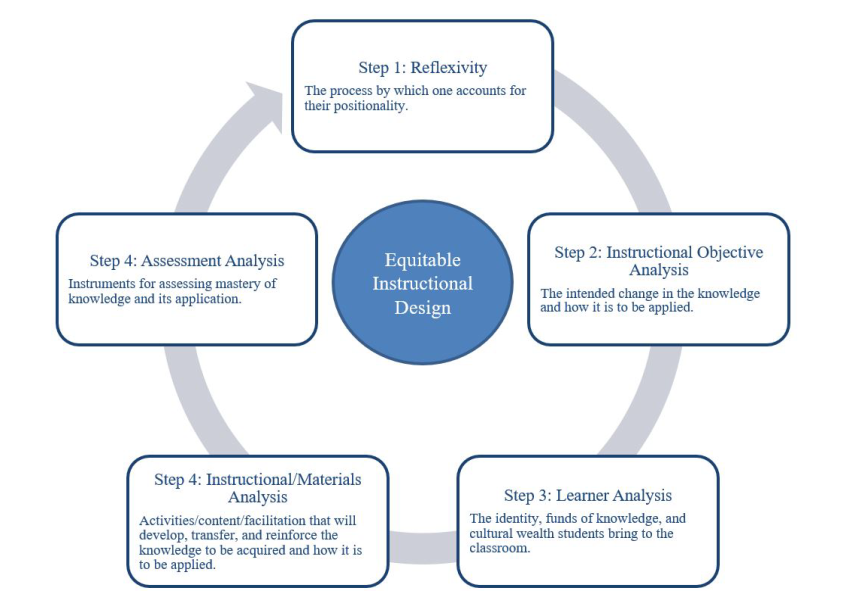
By integrating UDL (flexibility, engagement, representation) and UID (proactive accessibility, inclusive design) with a race-conscious lens, instructional objectives become tools for closing equity gaps rather than reproducing them.
Table 6: Equity-Focused Review of Instructional Objectives (Race-Conscious UDL + UID Lens)
| Review Dimension | What Faculty Should Consider | UDL Alignment | UID Alignment | Race-Conscious Equity Focus |
|---|---|---|---|---|
| Clarity of Objective | Is the objective clearly stated, measurable, and understandable to all students? | Supports comprehension through clear goals | Emphasizes simple, intuitive design | Reduces hidden academic expectations that disproportionately impact first-generation and racially minoritized students |
| Relevance & Representation | Does the objective reflect diverse perspectives, identities, and contributions? | Multiple means of engagement (culturally relevant content) | Inclusive instructional climate | Counters Eurocentric bias and validates the experiences of Black, Latinx, and other underserved students |
| Accessibility of Language | Is the language free of jargon or explained clearly for all learners? | Multiple means of representation (clarity, scaffolding) | Simple and intuitive instruction | Supports students navigating dominant academic language norms |
| Demonstration of Learning | Are there multiple ways students can meet the objective? | Multiple means of action & expression | Flexibility in use | Reduces bias in assessment and allows students to leverage cultural and academic strengths |
| Scaffolding & Support | Does the objective allow for varying levels of prior knowledge and preparation? | Supports comprehension and executive function | Tolerance for error and low barriers | Avoids penalizing students for inequitable prior educational access |
| Bias in Framing | Does the objective avoid deficit language or assumptions about student ability? | Engagement through inclusive framing | Inclusive climate | Shifts from “fixing students” to addressing systemic inequities impacting racially minoritized groups |
| Connection to Outcomes | Is the objective aligned with equitable student success outcomes (e.g., course success, persistence)? | Goal alignment and transparency | Structured and accessible design | Ensures objectives contribute to closing racial equity gaps, not reproducing them |
| Student Agency | Does the objective allow for student voice, choice, or ownership in learning? | Engagement and self-regulation | Community of learners | Empowers racially minoritized students whose voices are often marginalized in traditional classrooms |
| Cultural Responsiveness | Does the objective acknowledge or integrate students’ lived experiences and cultural knowledge? | Engagement and representation | Inclusive environment | Positions students’ cultural wealth as an asset rather than a deficit |
| Transparency & Expectations | Are success criteria clearly communicated and accessible? | Supports executive function and comprehension | Simple, intuitive structure | Reduces inequities caused by implicit or “hidden curriculum” expectations |
Table 7: How UDL and UID Advance Racial Equity Aligned with CCC Student Equity Metrics
| Dimension | UDL Contribution | UID Contribution | Aligned Equity Metric (CCC) | Racial Equity Impact |
|---|---|---|---|---|
| Access to Courses & Programs | Multiple means of representation ensure content is accessible to diverse learners | Proactive course design removes barriers before students enroll or engage | Access / Enrollment | Reduces disparities in who can successfully enter and engage in courses, especially for Black, Latinx, and first-generation students |
| Course Success (Pass Rates) | Multiple ways to demonstrate learning (action & expression) | Flexible assessments reduce bias and rigid evaluation structures | Course Success | Addresses racial equity gaps in pass rates by allowing students to demonstrate mastery in different ways |
| Retention & Persistence | Engagement strategies connect learning to students’ identities and goals | Inclusive course design fosters belonging and reduces friction points | Retention / Persistence | Increases persistence of racially minoritized students by improving engagement and sense of belonging |
| Transfer & Completion | Scaffolding and comprehension supports help students navigate complex academic pathways | Clear, intuitive course and program design reduces confusion and attrition | Completion / Transfer | Supports equitable progression through pathways, reducing racial disparities in completion rates |
| Equity in Gateway Courses | Flexible instructional strategies support diverse learning needs in high-impact courses | Redesign of course structure reduces systemic barriers in “weed-out” courses | Course Success (Gateway Courses) | Mitigates racialized failure patterns in foundational courses (e.g., math, English) |
| Student Engagement & Belonging | Culturally relevant content and multiple engagement strategies | Inclusive instructional climate and community of learners | Student Engagement (Vision 2030) | Counters racial isolation and increases connection for disproportionately impacted students |
| Closing Equity Gaps | Disaggregated design approach anticipates differences in learner needs | Structural redesign targets inequities rather than student deficits | All Metrics (Disproportionate Impact) | Directly addresses systemic causes of racial equity gaps rather than attributing them to students |
| Faculty Practice & Accountability | Faculty adapt teaching to learner variability | Faculty design courses to remove barriers and inequities | Institutional Effectiveness / Equity Goals | Positions faculty as responsible for improving racially equitable outcomes |
DECOLONIZING THE CURRICULUM
The concept of decolonizing the curriculum traces its contemporary roots to the 2015 “Rhodes Must Fall” movement in Cape Town, South Africa. Initially sparked by student protests demanding the removal of a statue of Cecil Rhodes from the University of Cape Town, the movement quickly expanded into a broader critique of the enduring legacies of colonialism in higher education. As scholar Sabelo J. Ndlovu-Gatsheni describes, the movement evolved into a call for “cognitive justice,” advocating for the transformation of curricula, the removal of colonial and apartheid-era symbols, the right to free and relevant education, cultural autonomy, and a reimagining of the university itself from one modeled on Western ideals (a university in Africa) to one rooted in local epistemologies and identities (an African university). Adekeye Adebajo, Executive Director of South Africa’s Centre for Conflict Resolution, emphasized that the removal of the Rhodes statue served as a “metaphorical call for the transformation of the university’s curriculum, culture, and faculty” elements that, for many Black South Africans, remained alienating and reflective of an entrenched Eurocentric heritage.
This movement reignited global conversations about whose knowledge is valued in academic spaces, and continues to inspire efforts to decenter Western epistemologies, amplify marginalized voices, and create more inclusive, contextually relevant curricula around the world.
What, then, does decolonizing the curriculum aim to accomplish? According to Rowena Arshad of the University of Edinburgh, decolonizing the curriculum is not about erasing or dismissing Western knowledge or historical narratives. Rather, it is about situating non-Western histories and knowledges within the broader context of imperialism, colonialism, and power, and critically examining why such perspectives have been historically marginalized and decentered in educational institutions. Arshad emphasizes that decolonization is not a prescriptive model, and cautions against searching for a one-size-fits-all definition or framework. Instead, she advocates for understanding decolonization as an approach—one that must be contextualized within specific disciplines and subject areas, responsive to their histories, content, and methods. The core objective is to interrogate dominant knowledge systems, create space for plurality of perspectives, and foster critical awareness of how power operates in curriculum design and delivery.
By embracing this reflective and contextual approach, educators move toward creating curricula that are more inclusive, critically engaged, and representative of the diverse intellectual traditions that shape human understanding.
Arshad recommends that those seeking to decolonize the curriculum begin with the following guiding points.
Table 8: Key Guiding Points to Decolonize Curriculum (Based on Rowena Arshad’s Work)
| Guiding Principle | Description | What It Looks Like in Academic Practice |
|---|---|---|
| Interrogate Power and Knowledge | Examine how knowledge is produced, whose knowledge is valued, and whose is marginalized | Critically reviewing syllabi to identify dominance of Eurocentric perspectives and including global and historically excluded voices |
| Decenter Dominant Narratives | Move beyond Western-centric frameworks and challenge the idea of a single “universal” canon | Incorporating scholarship from the Global South, Indigenous scholars, and scholars of color |
| Acknowledge Historical Context | Recognize the role of colonialism and systemic inequities in shaping disciplines and institutions | Teaching the historical roots of disciplines, including links to colonialism, racism, and exclusion |
| Value Multiple Ways of Knowing | Recognize diverse epistemologies and knowledge systems beyond Western traditions | Including oral traditions, community knowledge, and non-Western frameworks in course content |
| Critical Reflexivity (Faculty) | Faculty examine their own positionality, assumptions, and role in knowledge production | Reflecting on teaching practices, biases, and decisions about curriculum design |
| Student Voice and Co-Creation | Engage students as partners in shaping curriculum and knowledge | Co-creating assignments, incorporating student perspectives, and inviting critical dialogue |
| Inclusive Pedagogy | Use teaching approaches that support diverse learners and challenge inequities | Culturally responsive teaching, dialogic learning, and inclusive classroom practices |
| Challenge Deficit Narratives | Avoid framing marginalized groups as lacking or deficient | Highlighting resilience, contributions, and strengths of historically excluded communities |
| Embed Equity, Not Add-On Diversity | Move beyond token inclusion toward systemic curriculum transformation | Integrating diverse perspectives throughout the course rather than adding a single “diversity week” |
| Commitment to Ongoing Change | Decolonizing curriculum is continuous, not a one-time effort | Regular curriculum review, faculty development, and institutional accountability |
Anamika Twyman-Ghoshal and Danielle Carkin Lacorazza have developed an antiracist and decolonized teaching and learning framework that emphasizes that antiracist and decolonized teaching is not just about content inclusion, but about transforming the purpose, structure, and power dynamics of teaching and learning. It requires educators to actively name racism, redistribute authority in the classroom, and redesign curriculum to center justice and equity.
Table 8: Antiracist and Decolonized Teaching & Learning Framework
| Key Principle | Description | What It Looks Like in Academic Practice |
|---|---|---|
| Centering Race and Racism | Explicitly names and examines racism as a structuring force in education and knowledge production | Course content directly addresses racism, colonialism, and power rather than avoiding or minimizing them |
| Interrogating Systems of Power | Analyzes how institutions, disciplines, and curricula reproduce inequities | Critically examining disciplinary norms, canons, and whose knowledge is prioritized |
| Decolonizing Knowledge | Challenges Eurocentric dominance and includes marginalized epistemologies | Integrating scholarship from Black, Indigenous, and Global South scholars throughout the curriculum |
| Asset-Based Framing | Recognizes and values the strengths, knowledge, and experiences of racially minoritized students | Designing assignments that draw on students’ lived experiences and cultural knowledge |
| Critical Reflexivity (Faculty & Students) | Encourages ongoing reflection on identity, bias, and positionality | Faculty and students engage in reflective activities about power, privilege, and perspective |
| Student Voice and Agency | Positions students as co-creators of knowledge rather than passive recipients | Co-created assignments, dialogic learning, student-led discussions |
| Transforming Pedagogy | Moves beyond traditional, hierarchical teaching toward inclusive and participatory approaches | Collaborative learning, discussion-based classes, and community-engaged learning |
| Challenging Deficit Thinking | Rejects narratives that frame students of color as lacking | Using equity-minded language and focusing on institutional responsibility |
| Action-Oriented Equity | Links teaching to broader goals of social justice and institutional change | Designing courses that encourage civic engagement, advocacy, and real-world application |
| Ongoing Praxis | Views antiracist and decolonized teaching as continuous, iterative work | Regular revision of curriculum, incorporation of feedback, and sustained professional learning |
SOCIAL EMOTIONAL ENGAGEMENT
The social-emotional engagement of students is a critical component of creating an equitable learning environment, as it enables faculty to connect meaningfully across differences in race, class, gender identity, sexual orientation, learning needs, and age. Social-emotional engagement is rooted in the intentional use of empirically grounded practices and classroom activities that infuse social-emotional competencies into daily teacher–student interactions. These practices not only enhance the quality of classroom dynamics but also foster motivation, academic development, and inclusive teacher–student relationships.
Social engagement which includes both faculty-to-student and student-to-student interactions serves as a primary pathway to building trust, community, and relational safety within the classroom. In turn, this nurtures emotional engagement, reflected in students’ feelings and attitudes toward learning. Emotional engagement deeply influences “the extent or quality with which students are committed and actively involved in their learning,” as well as “the time, energy, and resources they devote to activities designed to enhance learning.”
An equitable learning environment must therefore be responsive to the social and emotional conditions under which learning occurs. Research consistently shows that increased social-emotional engagement contributes to improved academic achievement, particularly for historically marginalized student populations. For many such students, prior K–12 schooling experiences may have created stress, anxiety, or alienation, making the assimilation of discipline-specific language and frameworks particularly challenging.
As a result, it is essential for faculty to design systems of support that foster belonging, affirm students’ identities, and help them feel understood and valued. Faculty committed to equity must be intentional in crafting positive, inclusive learning environments that actively work to reduce learning-related stress and empower students to thrive.
To reflect on how equitable instructional design can foster such environments, consider the following quotes:
| “Looking at everything from a student’s overall wellness to what drives student interactions, teachers are given the diagnostic tools to look beyond content delivery. Research in higher education populations demonstrates that social and emotional adjustment is associated with positive academic outcomes, including academic performance and retention. Furthermore, social and emotional skills extend beyond academic contexts and outcomes, such as success in work, positive interpersonal relationships, and better mental health and overall well-being.” “The design of a positive, inclusionary learning environment can contribute to minimizing stress related to the assimilation of complex concepts and new terminology. Accomplished teachers base their practice on the fundamental belief that all students can learn and meet high expectations. Acknowledging the distinctive traits and talents of each learner, teachers are dedicated to and skilled at making knowledge accessible to all students. Educators are thus passionate about building meaningful relationships with students who can advance their understanding and experience success.” – Chiara Elmi |
For social-emotional engagement to flourish, faculty must recognize that education extends beyond content delivery. It begins with the understanding that caring is pedagogical and that meaningful learning is rooted in human connection, empathy, and relational trust. Faculty must engage in intentional caring behaviors, which involve demonstrating warmth, sensitivity to students’ academic and emotional states, and genuine attentiveness to students’ perspectives, opinions, and lived experiences.
These behaviors affirm the distinctive traits, cultural backgrounds, and talents that each learner brings to the classroom, validating their presence as integral to the learning community. By cultivating authentic, caring relationships, educators reduce the stress and anxiety many students—particularly those from historically marginalized backgrounds—may associate with academic environments, thus making knowledge more accessible and empowering.
As scholar Edmund R. F. Hewson affirms, “If learning is seen as a social and cultural process, then it depends on mastery and internalisation of social interactions, and this is where teachers actively contribute in creating the emotional climate of learning.” This underscores the essential role of faculty in shaping not only the academic, but also the emotional and cultural dimensions of the classroom environment.
Creating this climate is central to equity-minded practice: when students feel seen, heard, and valued, they are more likely to engage deeply, take intellectual risks, and persist in their educational journeys.
SUPPORT SYSTEM CULTIVATION
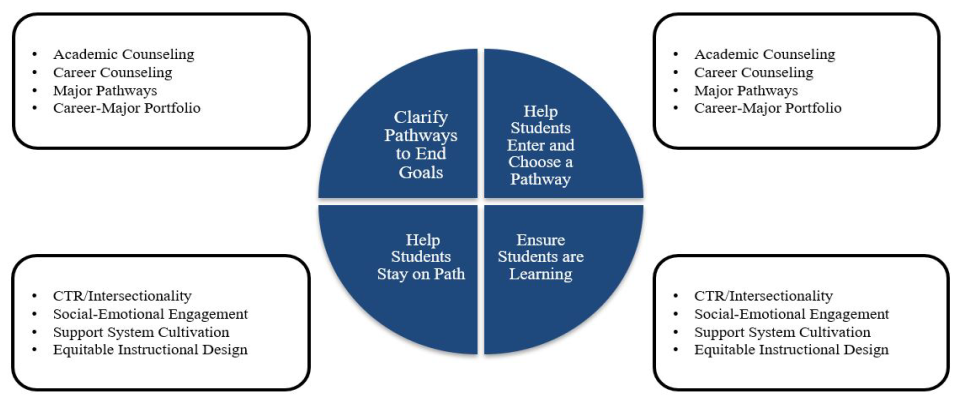
myPATH recognizes that creating an equitable learning environment and achieving equitable educational outcomes is not the responsibility of faculty alone—it is a shared commitment among all campus constituents. Achieving this requires intentional collaboration both within and beyond the classroom. Central to the myPATH model is the belief that the classroom must become the point of convergence for the Four Pillars of Guided Pathways, serving as the space where support systems are integrated, visible, and accessible to students.
Why the classroom? Because it is where students spend the majority of their time as they navigate the educational system. It offers the ideal environment for coordinating institutional support systems in a complementary and synergistic fashion, ensuring students experience not just instruction but comprehensive academic and personal support. The goal is to infuse the Four Pillars of Guided Pathways directly into the classroom and to decode the “hidden curriculum”—the often unspoken norms, expectations, and cultural codes of college—for students, especially those from historically minoritized backgrounds.
To accomplish this, myPATH fosters in-classroom collaboration among equity-minded institutional educators. These educators, when working in tandem with faculty, minimize confusion, enhance content mastery, and support students in achieving their academic goals. A key component of this collaborative model includes Peer Assisted Study Session (PASS) Mentors, who are embedded into classrooms to reinforce learning and build peer-to-peer support.
This model of shared engagement—what myPATH calls pedagogical partnerships—creates an inclusive and responsive classroom that benefits both students and faculty. It also highlights an institutional irony: while many programs that could significantly support historically marginalized students are available, their unit or programmatic restrictions often make access difficult. Through interdisciplinary and cross-departmental collaboration, myPATH reimagines the classroom as a programmatic hub, allowing all students to benefit from high-impact equity practices that were once isolated.
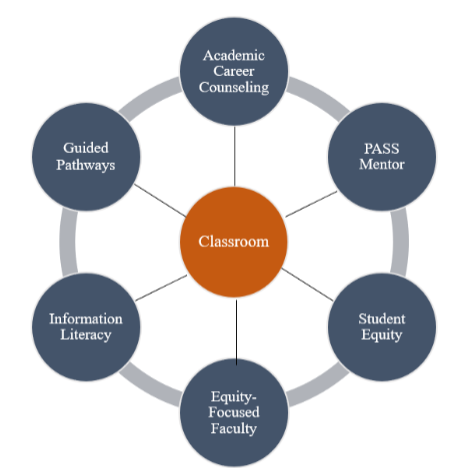
Furthermore, this collaboration allows multiple equity-minded perspectives to converge in support of student success. myPATH-designated courses exemplify this by embedding the following equity-minded practitioners directly into classroom learning environments, working alongside teaching faculty to cultivate support systems and promote equitable outcomes:
| Academic Counseling Faculty | Academic counseling services include assessment using multiple measures and diagnosis of students’ academic abilities, disabilities, strengths and weaknesses; help in clarifying academic goals and selecting a program of study; educational planning for transfer, associate degree, and certificate programs; assisting with clarifying choices and actions, as well as decision-making, planning, and transitioning; making referrals to other support services when a need is indicated; intervening when students’ academic performance is at risk; and providing follow-up (e.g., academic mentoring, early alert processes, and probation counseling). |
| Career Counseling Faculty | Career counseling faculty “teach the career development process and its importance in setting and achieving academic and life goals.” Career counseling faculty also “teach students to examine their lives as a whole—values, interests, aptitudes, and life circumstances. Students need to be made aware that career skills learned now, such as career search and decision-making methods, may be useful throughout a lifetime.” |
| Information Literacy Faculty | Information literacy faculty teach “integrated abilities encompassing the reflective discovery of information, the understanding of how information is produced and valued, and the use of information in creating new knowledge and participating ethically in communities of learning.” They assist student in having a greater role and responsibility in creating new knowledge through effective research inquiry and by using information, data, and scholarship ethically. |
| Peer Assisted Study Session (PASS) Mentor | The PASS Mentor Program assists students with course content through PASS sessions. In addition to discussing course content, PASS mentors also address study-related problems student may face and provide general advice on a wide range of topics relating to student equity and student success. PASS Mentors meet on a weekly basis with faculty to discuss specific issues, content or directed activities to be covered in PASS sessions, and to address specific challenges students are facing in mastering course content. During these sessions, both faculty and PASS mentors also discuss the means by which to best secure equitable outcomes in the course. |
The following chart shows how support system cultivation brings the four pillars of Guided Pathways from an institutional framework into the classroom.
IN CLOSING
The overview provided above was designed to introduce you to key strategies for equitizing your curriculum and for creating a programmatic experience for students within the classroom. It has also familiarized you with the essential components that define a myPATH-designated course—from instructional design rooted in equity to collaborative, student-centered support systems.
With this foundation in place, you are now ready to move forward to the final activity of the myPATH Equity Institute: the Capstone Project. This culminating experience will give you the opportunity to apply the concepts, frameworks, and practices explored throughout the institute to design a course or instructional unit that reflects your commitment to equity, inclusion, and student success.