LEARNING OBJECTIVES
- To understand the Vision for Success Goals and Objectives as well as the Vision 2030 Goals, Metrics, and Outcomes, and to analyze how myPATH addresses these priorities within the classroom setting.
WHAT IS myPATH?
myPATH is a pedagogical partnership model developed to address equity gaps through an organizational learning framework. It encourages faculty to critically examine their own teaching methods, beliefs about student learning, assignment design, and content delivery to identify and reduce practices that may contribute to inequitable outcomes. This model fosters institutional dialogue around equity by leveraging disaggregated completion data and promoting an equity-minded cognitive framework to interpret and act on the findings.
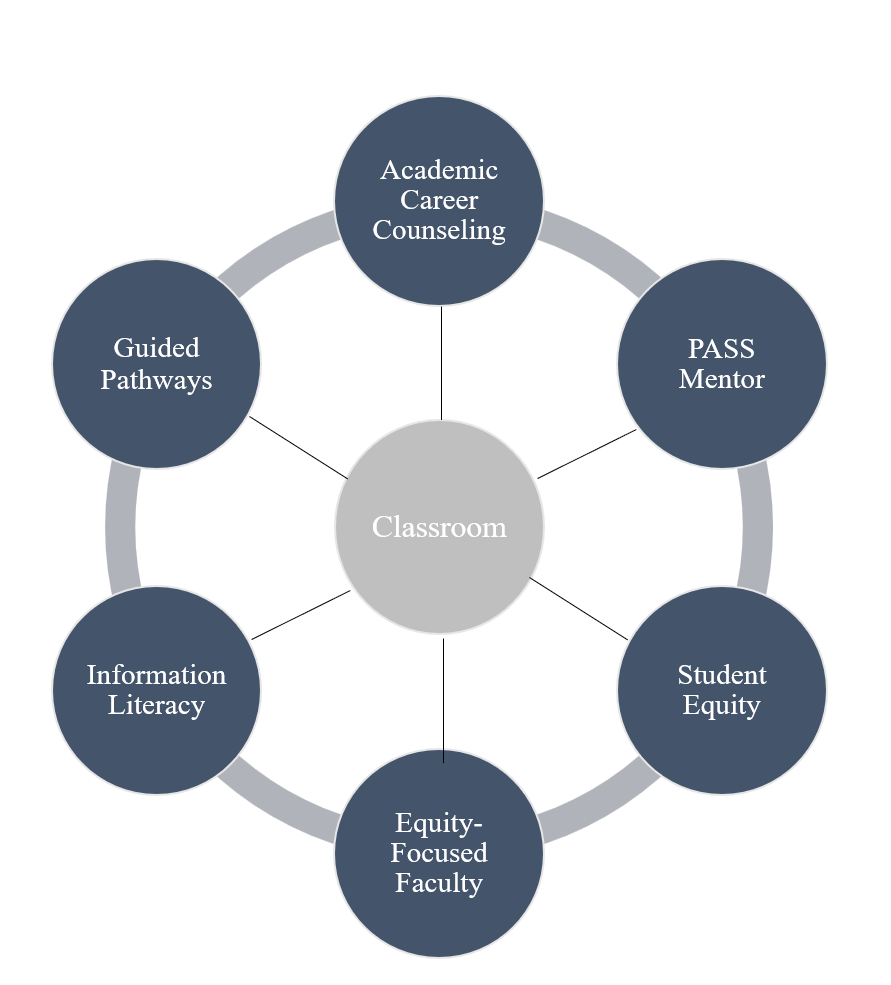
In alignment with Guided Pathways and Vision 2030 Goals, Metrics, and Outcomes, myPATH integrates counseling faculty, instructional faculty, library faculty, and PASS Mentors into the classroom experience. This collaboration creates a cohesive, student-centered support system designed to promote student success and eliminate equity gaps.
Ultimately, myPATH aims to deliver a programmatic and inclusive classroom experience for all students enrolled in myPATH-designated courses, ensuring equitable access to success-driven educational practices.
The myPATH Equity Institute is designed to introduce participants to the equity frameworks and principles that guide the myPATH model and are actively implemented by faculty in the classroom. The Institute serves as a structured professional learning experience that supports organizational learning and the development of an equity-minded teaching practice. Through a carefully scaffolded approach, the Institute incorporates key components such as:
- Organizational learning theory,
- Equity-focused cognitive frameworks, and
- Curriculum equitization strategies.
By engaging with these elements, faculty are equipped to reflect on and transform their instructional practices, aligning them with institutional goals for equity, inclusion, and student success.
The myPATH Equity Institute thus functions as both a professional development program and a strategic tool for advancing El Camino College’s equity mission within the classroom and across the institution.In addition, myPATH supports faculty in conducting audits of instructional objectives, course outlines of record, and syllabi to ensure alignment with equity-centered design and practices. These audits help identify and revise elements that may unintentionally perpetuate barriers to student success, thereby fostering more inclusive and supportive learning environments.
myPATH also includes structured instruction on the Guided Pathways framework and the Vision 2030 Goals, Metrics, and Outcomes, emphasizing their relevance to everyday classroom practice. Central to this model is the recognition that true equity in education requires intentional, interdisciplinary collaboration among teaching faculty, counseling faculty, information literacy faculty, and peer mentors. By integrating these roles within the classroom experience, myPATH aims to build a cohesive and responsive support system that advances equity, improves student outcomes, and fulfills the broader institutional mission of student-centered transformation.
WHY THE CLASSROOM?
The classroom is the epicenter of student experience at El Camino College. Over the course of any given semester, students spend the majority of their time in this setting engaging with course content, faculty, and peers. It is also the primary arena where equity gaps manifest, as retention and success are most often measured through course completion rates. For this reason, if we are to address equity in a meaningful way, the classroom must be the central site of intervention, and faculty must serve as the principal agents of change.

Faculty agency is at the core of myPATH’s design. It empowers instructors to examine and adjust their teaching practices, course content, and learning environments to ensure they do not inadvertently reproduce educational inequities. However, the first step in building a truly equitable classroom begins with self-inquiry: faculty must reflect on their own belief systems, how they perceive students, what assumptions they hold about students’ abilities and preparedness, and how these perceptions shape their instructional and curricular choices.
This reflective process also demands that educators critically explore how identity contingencies and stereotype threats can be perpetuated in learning environments, often unintentionally. Recognizing how our implicit biases influence classroom dynamics is vital to disrupting inequitable structures. The degree to which instructors understand and take ownership of this relationship between beliefs, equity, and agency directly impacts their ability to design equitable learning experiences.
| “Centering yourself in equity begins with a personal acknowledgment of who you are as a person and what constitutes your own belief systems, then authenticating those beliefs in your actions, and finally claiming full responsibility as a professional educator.” – Curtis Linton, The Equity Framework |
Through myPATH, faculty are guided to make this connection between personal belief, professional responsibility, and equity-minded instruction, transforming classrooms into intentional, inclusive spaces where all students have the opportunity to thrive.
VISION FOR SUCCESS AND VISION 2030
Student equity is a central priority for the California Community Colleges Chancellor’s Office (CCCCO). This priority if fundamental because the California Community College’s (CCC) mission is to ensure that “students from all backgrounds succeed in reaching their goals and improving their families and communities, eliminating achievement gaps once and for all.” This outcome recognizes that equity is not a peripheral concern but the foundation of student success and thus must be embedded into every level of institutional planning, practice, and accountability. As a participant in the myPATH Equity Institute, it is essential to first understand why the Chancellor’s Office places equity at the core of its system-wide vision, and then to explore how we, as educators, can actualize that vision within the classroom where student learning and institutional impact most directly intersect.
The CCC has long served as a key driver of social and economic mobility in the state. Its open-access structure and low tuition have allowed millions of students from varied backgrounds to pursue degrees, credentials, workforce training, and lifelong learning. However, despite this promise, the CCC system has struggled to consistently meet the diverse needs of its students. Persistent race specific equity gaps in retention, success, and completion rates reflect systemic challenges that must be addressed head-on.
That is why student equity is not just a priority but also a moral and institutional imperative. It acknowledges that not all students arrive with the same resources, opportunities, or social capital, and thus calls on educators and institutions to design inclusive, culturally responsive, and equitable learning environments. The CCCCO’s equity-centered policies, including the Vision for Success, Vision 2030, and Student-Centered Funding Formula, aim to align policy with practice placing faculty agency and classroom transformation at the heart of the solution.
| The Five Community College Challenges Identified in the Vision for Success 1. Most students who enter a community college never complete a degree or certificate or transfer to a 4-year university. 2. California Community College students who do reach a defined educational goal such as a degree or transfer take a long time to do so, often accumulating many excess course credits along the way. 3. Older and working California Community College students are often left behind in the system, lacking services and financial aid that suit their needs. 4. California Community Colleges are more expensive than they appear—both to students and taxpayers— because of slow time-to-completion and a lack of financial aid to cover students’ living expenses. 5. Serious and stubborn achievement gaps persist across the California Community Colleges and high-need regions of the state are not served equitably. |
It is within the context of these ongoing challenges, and the CCC’s educational and fiscal reforms, that myPATH seeks to equip faculty with the frameworks and guidelines necessary to translate system-wide student equity priorities into classroom-level practice. Recognizing that the classroom is the most immediate and impactful environment for student engagement, learning, and success, myPATH is grounded in the belief that institutional change must begin with instructional transformation.
By fostering equity-minded learning environments, myPATH aims to support faculty in directly addressing the achievement gaps disproportionately experienced by historically minoritized student populations. This includes helping educators interpret and implement the goals set forth in major CCCCO initiatives such as the Vision for Success, Vision 2030, and the Student-Centered Funding Formula. By doing so, myPATH can help ensure that these policies result in tangible improvements in student experiences and outcomes.
Through its structured model of faculty inquiry, curriculum equitization, cross-functional collaboration, and reflective practice, myPATH bridges the gap between policy and pedagogy. This approach facilitates turning statewide equity mandates into actionable strategies within the classroom.
VISION FOR SUCCESS EXECUTIVE SUMMARY
The CCCO has recently released the Vision for Success Executive Summary which aims “to give a clear-eyed, honest look at our performance as a system, both where we are excelling and where we are falling short.” It identifies six goals for improvement to be achieved by all CCCs within the next five years.
| Vision for Success Executive Summary Goals 1. Increase by at least 20 percent the number of California Community College students annually who acquire associate degrees, credentials, certificates, or specific skill sets that prepare them for an in-demand job. 2. Increase by 35 percent the number of California Community College students transferring annually to a UC or CSU. 3. Decrease the average number of units accumulated by California Community College students earning associate degrees. 4. Increase the percent of exiting CTE students who report being employed in their field of study. 5. Reduce equity gaps across all of the above measures through faster improvements among traditionally underrepresented student groups. 6. Reduce regional achievement gaps across all of the above measures through faster improvements among colleges located in regions with the lowest educational attainment of adults. |
The goals outlined in the Vision for Success are ambitious by design, reflecting a system-wide effort to eliminate equity gaps, increase student success, and align educational outcomes with workforce needs. Achieving these goals will require collaborative action across all sectors of the CCC system. To support this effort, the CCCCO has called on all CCCs to adopt and implement seven core commitments. These commitments serve as guiding principles to drive institutional change, inform decision-making, and ensure that every college is actively working toward the Vision for Success goals in a coherent and equity-centered way.
| Seven Core Commitments 1. Focus relentlessly on students’ end goals. 2. Always design and decide with the student in mind. 3. Pair high expectations with high support. 4. Foster the use of data, inquiry, and evidence. 5. Take ownership of goals and performance. 6. Enable action and thoughtful innovation. 7. Lead the work of partnering across systems. |
GUIDED PATHWAYS
The CCC Chancellor’s Office has identified Guided Pathways as the model that can best achieve the goals set forth by the Vision for Success. It is a model that “engages college administration, faculty, and staff to enact comprehensive changes across an entire college.”
At the core of the Guided Pathways framework is a commitment to student equity. The model is designed to transform how institutions serve students by ensuring that every learner Has a clear, supported path to achieving their educational and career goals. Guided Pathways seeks to accomplish two primary objectives. First, by providing all students with a set of clear course-taking patterns that promotes better enrollment decisions and prepares students for future success. Second, by integrating support services in ways that make it easier for students to get the help they need during every step of their community college experience.
To fulfil its primary objectives, Guided Pathways is built upon four key pillars. These pillars provide a comprehensive framework for redesigning the student experience from entry to completion, with a particular focus on supporting historically minoritized student populations.
| The Objectives of the Four Pillars Create curricular pathways to employment and future education. Ensure all courses are designed as part of a coherent pathway with a clear outcome, either transfer or a career outcome. Help student choose and enter their pathway. Help students explore career and/or transfer options before they begin college and extensively in their first year. Help students stay on their path. Ensure students can easily track their own progress and receive ongoing, intrusive advising. Data systems monitor student progress. Students are provided support or redirected if they fall off track. Ensure that Learning is happening with intentional outcomes. Create learning outcomes for every course and program are clear to the student and tied to a specific transfer, completion, or workforce outcome. Students are engaged in active, collaborative learning experiences. |
Table 1: myPATH Alignment with the Four Pillars of Guided Pathways
| Pathway Pillar | myPATH Activities that Support the Pillars |
|---|---|
| Clarifying the path for students. | Pedagogical Partnerships: Academic/Career Counselors Academic planning Career exploration Student Support/Services Exploration Career/Major Portfolio |
| Helping students get on a path. | Pedagogical Partnerships: Academic/Career Counselors Academic planning Career exploration Student Support/Services Exploration Career/Major Portfolio SEA Achievement Academies |
| Helping students stay on their path. | Pedagogical Partnerships: myPATH Designated Courses PASS Mentor Program Equitized Curriculum Equity-minded faculty Affinity Center Support Information literacy Learning communities Career/Major Portfolio SEA Achievement Academies |
| Ensuring students are learning. | Pedagogical Partnerships: myPATH Designated Courses PASS Mentor Program Equitized Curriculum Equity-minded faculty Affinity Center Support Information literacy▪ Learning communities |
VISION 2030
Vision 2030, building on the foundation laid by the Vision for Success, reaffirms and expands the California Community Colleges system’s commitment to equitable access, support, and success. What distinguishes Vision 2030 is its proactive approach to advancing socio-economic mobility for historically minoritized students. To accomplish this, the CCCO acknowledges that “We are no longer waiting for students to come to us.” Instead, the system is actively working to bring college to students wherever they are. This includes in their communities, in the workforce, online, or in returning to education later in life.
At the core of Vision 2030 is a deep and explicit commitment to student equity. The CCCO has made it clear that “each and every outcome will be disaggregated for underrepresented students of color (particularly underrepresented men of color), low-income students, and students with disabilities.” This focus ensures that systemic inequities are not only acknowledged but directly addressed through policy, practice, and accountability. The Vision 2030 Goals are organized to ensure that access, support, success, and economic mobility are realized for all students, especially those who have been historically minoritized within higher education.
| The Vision 2030 Goals Goal 1: Equity in Success- Ensure the academic and career success of all Californians who are current and prospective California community college students. Goal 2: Equity in Access – Broaden the opportunities for all Californians to participate in higher education by starting or continuing their higher education at a California community college. Goal 3: Equity in Support – Partner with other systems, agencies, institutions and community-based organizations to provide students the academic, financial and social supports necessary to thrive by taking education opportunities and the accompanying support to Californians. |
myPATH Vision 2030 Goal, Metric and Outcome Alignment
| Goal | Outcomes and Metrics | myPATH |
|---|---|---|
| Goal 1: Equity in Success: Ensure the academic and career success of all Californians who are current and prospective California community college students. | Outcome 1: Completion – Increase with equity the number of California community college students who complete a meaningful educational outcome. Outcome 2: Baccalaureate Attainment – Increase, with equity, the number of California community college students who earn an Associate Degree for Transfer / transfer to California State University (CSU) or University of California (UC) / transfer to non-profit private/independent four-year institutions. | myPATH Designated Classes *Equity-Minded Faculty *Equitized Curriculum *Career/Major Assignment Embedded Counselor *Academic Planning *Career Exploration *Student Support/Services Exploration PASS Mentor *Academic and Peer Mentorship |
| Goal 2: Equity in Access: Broaden the opportunities for all Californians to participate in higher education by starting or continuing their higher education at a California community college. | Outcome 4: Student Participation – Increase, with equity the number of students attending a California community college, with particular emphasis on the number of underserved Californians. | myPATH through the Social Science Pathway has worked with Outreach and The Promise. This will be revisited, and Marketing will also be contacted. |
| Goal 3: Equity in Support: Partner with other systems, agencies, institutions and community-based organizations to provide students the academic, financial and social supports necessary to thrive by taking education opportunities and the accompanying support to Californians. | Outcome 5: Maximizing Financial Aid – Increase with equity the number of California community college students receiving state and federal aid for which they are eligible to better support their educational journey. Outcome 6: Reduce Time to Completion – Decrease with equity the number of units in excess of 60 units for the Associate Degree for Transfer (ADT). | myPATH Designated Classes *Equity-Minded Faculty *Equitized Curriculum *Career/Major Assignment Embedded Counselor *Academic Planning *Career Exploration *Student Support/Services Exploration |
EDDC78222(a)
To effectively implement the goals outlined in the Vision for Success, the CCCCO introduced a revised funding formula that aligns financial incentives with student achievement and equity. This Student-Centered Funding Formula (SCFF) was designed not only to support the broader system reform efforts, but also to ensure that student equity remains a top priority in how colleges are resourced and held accountable. In direct response to this equity-centered focus, EDC 78222(a) was enacted by the California Legislature on September 17, 2018. Under EDC 78222(a), all California Community Colleges (CCCs) are required to develop and submit a Student Equity Plan using a standardized template.
| Key Equity Plan Objectives 1. Three-year measurable goals for both the overall student population and for each student group found to be experiencing disproportionate impact, 2. Specific strategies to address gaps in key success indicators such as access, retention, transfer, completion, and workforce outcomes, and 3. A clear process for evaluating progress using disaggregated data to inform institutional practice and continuous improvement. |
This legislation also established the Student Equity and Achievement (SEA) Program, consolidating multiple equity-focused initiatives under a unified structure. The stated purpose of the SEA Program is “To advance the system-wide goal to boost achievement for all students, with an emphasis on eliminating achievement gaps for students through equitable access, support, and completion.”
This legislative and fiscal framework makes it clear that equity is no longer optional but rather it is foundational. CCCs are now funded and evaluated not just on enrollment numbers, but on student success and equity outcomes experienced by historically minoritized students.
DISAGGREGATED DATA AND CORE EQUITY METRICS
Disaggregated data inquiry at El Camino College, using the CCCCO’s equity metric, has identified specific student populations that are experiencing disproportionate impact in key areas of academic achievement and completion. The following student populations have been identified at El Camino College.
- American Indian or Alaksa Native
- Black or African American
- Disabled
- Foster Youth
- Hispanic or Latino
- LGBT
- Native Hawaiian or Pacific Islander
- Veteran
These identified groups reflect the broader equity challenges faced across the CCC system and serve as indicators for the development of targeted interventions under SEA and institutional initiatives such as myPATH.
The CCCCO has established a set of equity metrics to identify and address disproportionate impact among student populations. These metrics serve as the core for equity planning, funding allocation, and institutional accountability. Colleges are expected to direct SEA funding toward strategies and practices that demonstrably improve outcomes for historically minoritized students in these areas.
| Core Equity Metrics Identified by the Chancellor’s Office Access. The proportion who enrolled at a CCC in the selected year. Retention. The proportion retained from fall to spring at a CCC in the selected year, excluding students who completed an award or transferred. Transfer to a four-year institution. The number who exited the community college system and transferred to a postsecondary institution within the selected year. Completion of transfer level math and English. The proportion who completed both transfer-level math and English in their first academic year of credit enrollment at a CCC. Earned credit certificate over 18 units, associate degree, CCC bachelor’s degree. The unduplicated count of students who earned a Chancellor’s Office approved certificate and/or associate degree and had an enrollment in the selected or previous year. |
myPATH SEA Metric Alignment
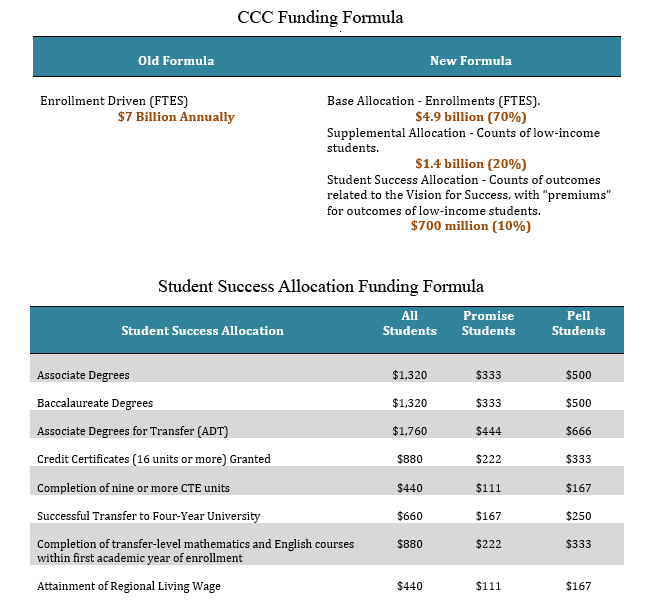
To drive the adoption and implementation of the SEA goals, the CCCCO has established a new funding formula that shifts the way colleges are resourced. Under the previous formula, funding was based primarily on enrollment, measured through Full-Time Equivalent Students (FTES). While this approach ensured open access, it did not incentivize colleges to support students through to completion or address persistent equity gaps. In contrast, the new Student-Centered Funding Formula (SCFF) introduces a more holistic and outcomes-driven model. This redesigned funding model is intended to incentivize colleges to:
- Align with state’s priorities for education and training.
- Progress toward the Vision for Success adopted by the Board of Governors.
- Providing additional resources to groups of students that have faced barriers to success.
IN CLOSING
The overview presented in this module has introduced you to several major reforms currently underway at the CCC. They are aimed at ensuring that higher education is not only accessible, but also equitable for every student. These reforms reflect a fundamental shift from a focus on enrollment and access alone, to a system-wide emphasis on student outcomes, equity, and institutional accountability. At the heart of these reforms is equity as a call to action. It requires thoughtful, intentional work from all educators to recognize and remove systemic barriers that disproportionately affect historically marginalized students.
Before proceeding, take a moment to reflect on the critical role you play as an instructor in these reforms. Your instructional practices, your engagement with students, and your willingness to interrogate and improve your teaching are central to transforming equity from a system goal into a classroom reality.