
What is a Course Outline of Record (COR)?
- “The official Course Outline of Record (COR) defines the content, objectives, methods of instruction and evaluation, sample textbooks and instructional materials for the course, and more. It establishes the number of units for the course plus the number of hours of instruction and will list any prerequisite(s) or corequisite(s) required for the course. In order to ensure that a qualified instructor is teaching the course, each course must be assigned one or more disciplines from the Disciplines List, and the course maximum per class section should also be recorded on the COR or an addendum to the COR (although local bargaining processes may dictate slightly different procedures). If the course can be taught in a shortened time frame, such as a 3-, 4-, 6- or 8-week session, then the appropriate shortened term lengths may be noted on the COR.”
- “The COR provides the roadmap for any instructor assigned to teach the course which makes it the key document for articulating courses and assuring university partners that students have been evaluated on the identified content of the course. This document is the single most important piece of information for establishing prerequisites or corequisites via content review. Faculty will want to review CORs with great care and critical analysis before asking the curriculum committee to approve a new or modified course. The ASCCC paper, The Course Outline of Record: A Curriculum Reference Guide Revisited, published in 2017, provides basic information about what must be included in the COR along with tips for writing an effective outline. Most importantly, all teachers teaching the course must adhere, at a minimum, to the COR, regardless of location or modality of instruction.”
Must the COR Reflect Culturally Responsive Curriculum and Diversity, Equity, and Inclusion?
The Academic Senate for California Community Colleges is working to integrate this as a requirement in Title 5. See below.
Adding Culturally Responsive Curriculum, Equity Mindedness and Anti-Racism to Course Outline of Record (COR) Requirements in Title 5 Fall 2021 Resolution Number 09.01
Whereas, The Course Outline of Record (COR) is at the center of local curricular process [1]; its required elements have been outlined in California Code of Regulations Title 5 including Section 55002 and the application of those requirements is detailed in the Program for Course and Approval Handbook (PCAH);
Whereas the elements of the COR need to be integrated so each reinforces the purpose of the other elements and obvious relationships should be built between course objectives, methods of instruction, assignments, and methods of evaluation;
Whereas, the California Community Colleges Chancellor’s Office (CCCCO) through its Call to Action [2] calls for campuses to “create an action plan to create inclusive classrooms and anti-racism curriculum,” including calling for faculty to “evaluate all courses for diversity of representation and culturally-relevant content”; and
Whereas, The Academic Senate for California Community Colleges (ASCCC) through its mission, planning documents, webinars, and events have committed to promoting culturally responsive curriculum in the California Community College system including Resolution 3.04 Spring 2020 [3] which directs the ASCCC to “develop resources identifying effective practices for anti-racist, equitable, and inclusive instructional strategies”;
Resolved, That the Academic Senate for California Community Colleges work with the California Community Colleges Chancellor’s Office to revise California Code of Regulations Title 5 including section 55002 titled “Standards and Criteria for Courses” to include a component of culturally responsive curriculum, equity mindedness and anti-racism integrated into the COR that allows for local control on how that requirement is fulfilled; and
Resolved, That the Academic Senate for California Community Colleges work with the California Community Colleges Chancellor’s Office to include in future publications, webinars, and other resources guidance and multiple examples of how to infuse cultural responsiveness, equity mindedness and anti-racism in the COR.
Why So much Emphasis on the COR?
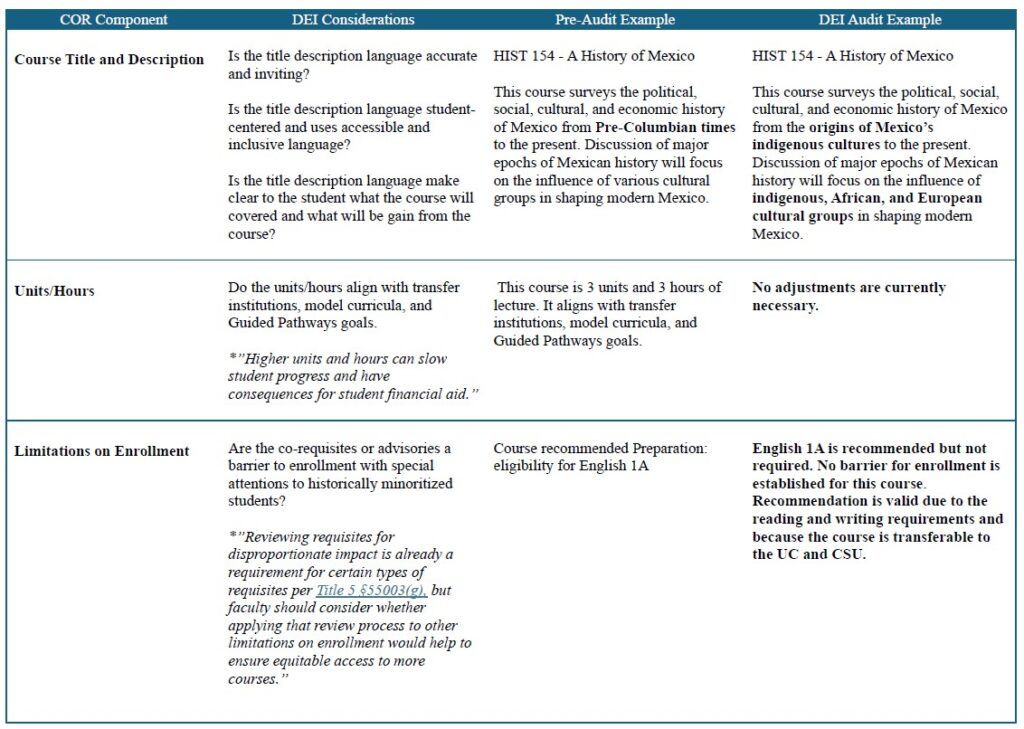
The COR has been described as being “essential to all aspects of curriculum at our colleges and drives the decisions we make as educators in the implementation of teaching strategies and course design.” It is the vehicle through which educators can create and provide our diverse student populations a curriculum that is relevant, culturally responsive, and equitable. Ensuring that our CORs reflect these objectives should also be at the heart of institutional equity work. To assist you in performing a DEI audit of your COR, a rubric with provided below. The rubric is divided into four colums. The first column identifies a specific component of the COR. The second column provides questions to consider when auditing a COR component. The third column provides details about the current state of the COR component. The fourth column provides and example of a DEI adjustment to the COR component.
Additional Resources for DEI COR Audit
- California Community Colleges: DEI in Curriculum: Model Principles and Practices
- ASCCC OERI Inclusion, Diversity, Equity, and Anti-Racism (IDEA) Framework and Implementation Guide September 2023