
Before faculty can begin infusing equitable entry points into their classroom and curriculum, they must first know their student’s identity and experiences. One way to accomplish this objective is by having students share who they are with faculty. Identity (personal and social) is the “set of traits and characteristics, social relations, roles and group membership that define who one is.” These identities can be self–claimed or ascribed by others. An individual’s identity impacts how one perceives and mediates the world and their place in that world. For example, a faculty members’ identity will undoubtedly impact their curricular and pedagogical approaches to the classroom. It will also define their interactions and relationships with students. In the same manner, a student’s identity will impact how they perceive and approach learning in the classroom.
Funds of Identity
Funds of Identity: An Assests-Based Toolkit of Student Supports
The concept of Funds of Identity (FOI) comes from a theory of learning that emphasizes the importance of recognizing and using students’ cultural, linguistic, and personal backgrounds to enhance their educational experiences. FOI is like a “toolbox” of resources that people gather over time. These resources are shaped by historical, cultural, and social experiences and “are essential fora person’s self-definition, self-expression, and self-understanding.”
A core belief of FOI is that educators should use the knowledge, skills, and experiences that students themselves feel are valuable (Veerman, et al., 2023), and which students use to define and express who they are (Esteban-Guitart & Moll, 2014). In doing so, FOI becomes a way for teachers to enhance classroom practice while giving their students a richer understanding of academic content and motivating them to learn. Teachers can also use FOI approaches to strengthen assets-grounded and culturally sustaining practices. Going further, FOI can be integrated into teacher professional development programs in which they go through the process of exploring their own FOI to better understand and create their pedagogical values.
The following is a student activity entitled Who Am I? The activity helps faculty gain insights about how students themselves define their identity. Using this information as a foundation, faculty can now create equity-minded designs for the classroom that taps into their student’s identity. More specifically, the activity’s objectives seek to accomplish the following:
- To have students reflect on what makes up their identity.
- To have students explore if their identity grants them societal/cultural advantages or does it produces societal/cultural disadvantages.
- To have students explore how they are perceived because of their identity and how their identity shapes how they perceive the world around them.
- To have students revisit the factors that shape social power and explore if identity plays a role in its construction.
Part 1 of this activity asks students to reflect on identity by examining the identity wheel and the definition list. Once students have reviewed this material, students will then begin the process of filling in the identity wheel.
Part 2 of the activity will give students the opportunity to share details about their identity through an anonymous Google form. You can access a copy of the form here: Identity Wheel Google Form Download.
The details that students share can help drive equitable instructional design. Take a moment to review the following chart. The information recorded in this chart was from an Identity Wheel activity administered in a Social Sciences 101 course in Fall 2020.
- What can be learned about how students perceive themselves and the experiences they have lived?
- How do they believe they learn best?
- How can a faculty member use information from this activity to help create an equitable learning environment?
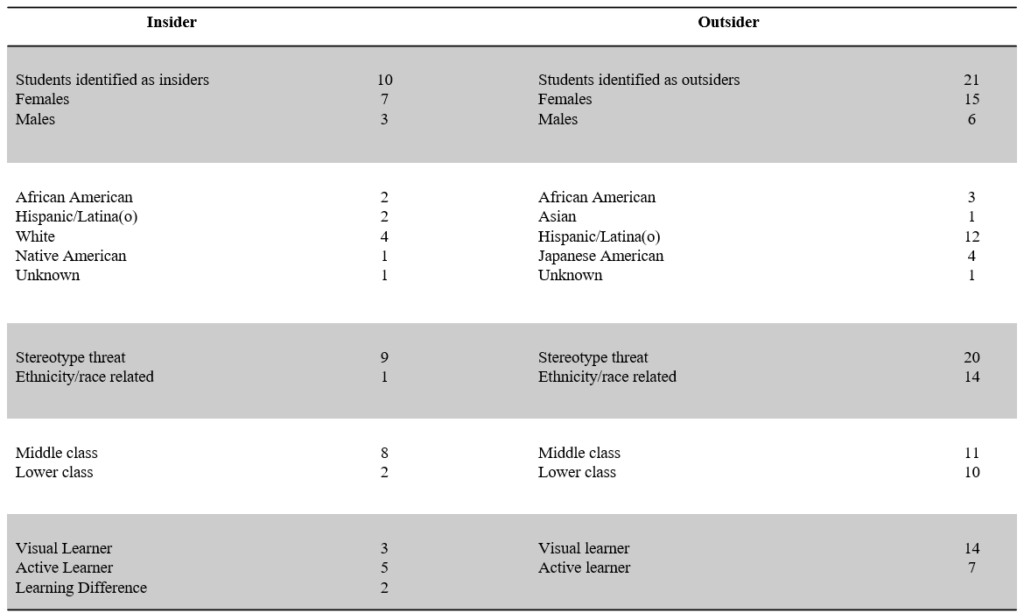
What is of particular interest is if they define themselves as an Insider or Outsider. Insiders are members of dominant social groups privileged by birth or acquisition who have an advantage over members of the outsider groups through societal/cultural “norms” and institutional biases. Outsiders are members of social identity groups who are discriminated against, marginalized, disenfranchised by societal/cultural “norms” and institutional biases. Below are the activity instructions that are provided to students.
Additional Resources
- Bartlett, Jackson Christopher (2022). “Navigating Social Identity in the Classroom.” Center for the Advancement of Teaching Excellence at the University of Illinois Chicago.
- Heather Van Mullen, Who Am I? A Strategy for Teaching About Power and Privilege
Who Am I?
What is identity? Identity (personal and social) is the “set of traits and characteristics, social relations, roles and group membership that define who one is.” These identities can be self–claimed or ascribed by others. Individuals also possess funds of knowledge, “skills, abilities, ideas, practices and ways of knowing accumulated and internalized from everyday life.” Funds of knowledge are acquired through an individual’s historical interaction with their family life, culture, and community. This activity is meant to have you critically reflect on your identity and explore the ways others may perceive your identity. The assignment specifically asks you to consider this within the context of the social norms at El Camino College and your community. Take a moment to complete the identity wheel below by ascribing a specific to each of the categories listed. In the inner circle, record the identities that are the most important or salient to you. In the outer circle, record the identities that are less important or salient to you. You may leave blank the ones that do not apply to you. When you finish transfer you will transfer your information to an anonymous Google form.
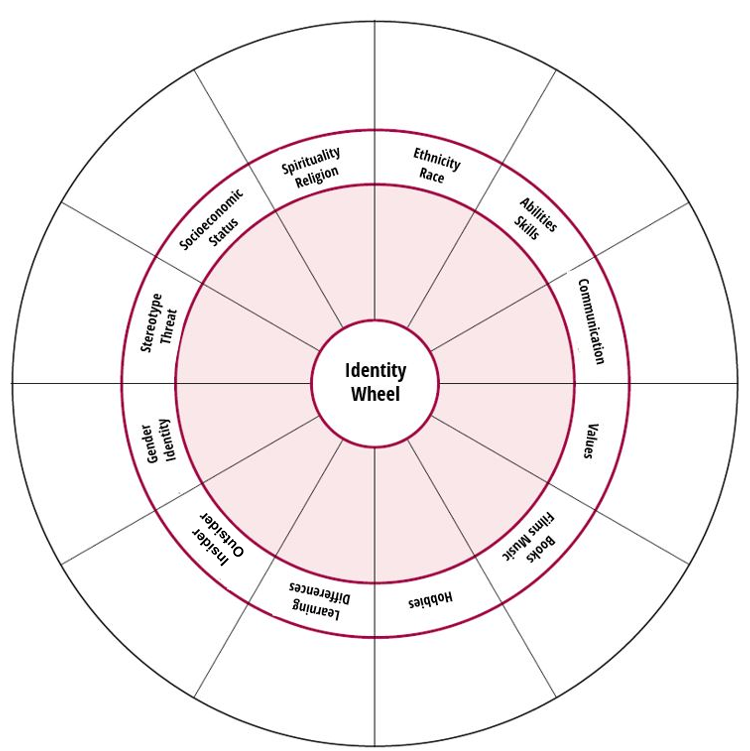
Identity Wheel Definitions
Abilities/Skills: Tasks that you naturally do well, talents and strengths.
Books, Films, Music: Genres or specific works one enjoys listening, reading and viewing.
Communication: “The method in which one interacts with others on a daily basis. This can include spoken language(s) (English/Spanish), sign language and/or other methods.”
Ethnicity/Race: “Ethnicity is an individual’s awareness of membership in a distinct group and of commitment to the group’s cultural values. Race is classification of human beings into different categories on the basis of their physical characteristics.”
Gender Identity: “One’s innermost concept of self as male, female, a blend of both or neither – how individuals perceive themselves and what they call themselves. One’s gender identity can be the same or different from their sex assigned at birth.”
Hobbies: Activities one enjoys doing on their free time.
Identity: The set of traits and characteristics, social relations, roles and group membership that define who one is. An individual’s identity impacts how one perceives and mediates the world. These identities can be self –claimed or ascribed.
Learning Differences: The spectrum of individuals who learn differently.
Religion Spirituality: Religion is the belief in and worship of a god or gods, or any such system of belief and worship. Spirituality is individual and group efforts to find meaning for existence within or independent of organized religion.
Socioeconomic Status: “It encompasses income, educational attainment, financial security, and subjective perceptions of social status and social class.”
Stereotype Threat: “It describes a situation in which a negative stereotype about a persons’ group is made and the adverse impact it can have on that individual.”
Values: “Ideals or principles that determine or guides individuals on how they conduct their lives and their choices.”
Insider/ Outsider: Insiders are “members of dominant social groups privileged by birth or acquisition who have advantage over members of the target groups through societal/cultural “norms” and institutional biases. Outsiders are members of social identity groups who are discriminated against, marginalized, disenfranchised by societal/cultural “norms” and institutional biases.”