
One of the most important principles of learning that all faculty should be aware of when creating instructional objectives and content that supports that objective is transfer of learning.
Transfer of Learning
G. Steiner, Cognitive Psychology of Transfer of Learning
“Transfer of learning means the use of previously acquired knowledge and skills in new learning or problem-solving situations. Thereby similarities and analogies between previous and actual learning content and processes may play a crucial role.”
Understanding transfer of learning is important because it brings to the instructor’s attention that not all students will come into a classroom with the same prior knowledge or experiences. This understanding in itself needs to be a starting point when creating equitable instructional objectives as it will help guide instructional techniques, classroom activities, and examples cited to ensure meaningful learning is taking place for all students.
There is another side to transfer of learning that is equally important for faculty to consider. Students bring learning assets and experiences to the classroom through identity, funds of knowledge, and cultural wealth that can serve as points for transfer. When faculty tap into these student assets through transfer of learning, this facilitates generative learning, “the process of constructing meaning through generating relationships and associations between stimuli and existing knowledge, beliefs, and experiences.” Thus, transfer can serve as segue between instructional objectives and equitable educational outcomes. Transfer of learning plays an important role in instructional principles that foment generative processing.
A common misconception is that to make transfer of learning equity-centered it needs to be race/ethnicity-specific. This is not always the case. Transfer of learning can be achieved with essential questions. Essential questions are structured in a manner that stimulate thought, provoke inquiry, and spark more questions. They can “serve as doorways or lenses through which learners can better see and explore the key concepts, themes, theories, issues, and problems that reside within the content.” Essential questions can be framed through an equity lens without being race/ethnicity specific but allows historically minoritized students to share their lived experiences and how these experiences relate to the content, or better yet, how the content relates to` their experiences.
Consider the example provided below:
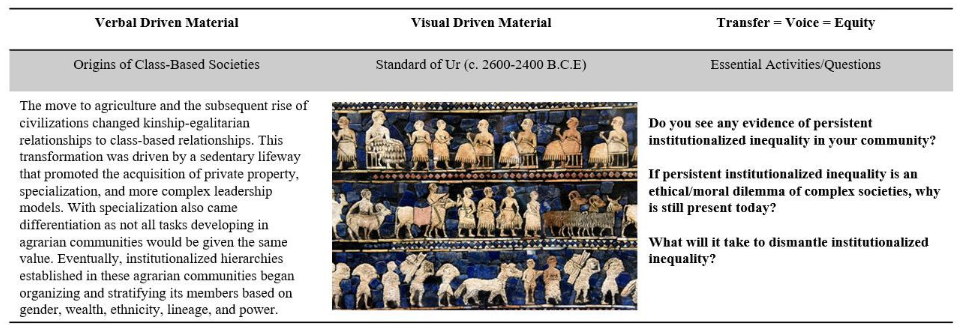
- Instructional Objective: Students will analyze how the move from a hunting and gathering lifeway to an agrarian lifeway facilitated the rise of institutionalized inequality.
- Dual Channel Instructional Materials: verbal driven material (lecture, concepts, and definitions), visual driven material (artifacts)
- Transfer of Learning: essential equitable questions to facilitate generative learning
In addition to the instructional materials and the processes for facilitating information and knowledge construction, it is equally important to evaluate whether or not assessment measures are also equitable. The purpose of an assessment is to determine what a learner has learned during or after instruction has taken place.
Additional Resource
Steven C, Pan and Pooja K. Agarwal. Retrieval Practice and Transfer of Learning: Fostering Student’s Application of Knowledge.