The following is a student activity is entitled My Community Cultural Wealth. The activity provides students with an opportunity to share with others the community cultural wealth they bring with them to the college environment and how it helps them navigate the institution where they have matriculated.
Cultural Wealth
everylearner – Cultural Wealth in Higher Education: Putting Assets-Based Perspectives into Practice
Cultural wealth is the reservoir of personal and community resources an individual may have beyond their income or accumulated financial wealth. Many examples of cultural wealth derive from an individual’s experience navigating or resisting bias and inequities, including traits such as resilience, social justice orientation, and social networks. Cultural wealth illuminates an individual’s abilities and assets rather than calling attention to their supposed lack of skills. The concept of cultural wealth was first proposed in 2005 by Dr. Tara Yosso, then Associate Professor in the Department of Chicana and Chicano Studies at the University of California, Santa Barbara in the article, “Whose Culture Has Capital? A Critical Race Theory Discussion of Community Cultural Wealth.” Rather than focusing on how a person’s race or ethnicity might give them less of the cultural capital that a predominantly white and middle-class environment values, Yosso instead focuses on the wealth of cultural capital that is being undervalued. Identifying cultural wealth necessarily de centers dominant perspectives.
Identifying cultural wealth necessarily de-centers dominant perspectives. For example, a student may have code-switching skills or experience acting as the family translator. Identifying and beginning to work with those assets shifts traditional questions about a student’s college readiness to questions about the college’s readiness for the student. In this way, cultural wealth pedagogy strives to reduce equity barriers for Black, Latino, Indigenous, poverty-affected, and first-generation students by theorizing and investigating innovative educational practices.
For faculty, an understanding of their student’s community cultural wealth will allow them to find avenues for giving historically minoritized students a voice and creating an equitable learning environment.
The activity’s objectives seek to accomplish the following:
- To have students reflect on the community cultural wealth they bring with them to a college environment.
- To have students explore the different sources of capital culture that shapes their community cultural wealth and how this capital culture has helped them navigate the college environment.
- To have faculty learn about student community cultural wealth and find ways to integrate cultural capital into the classroom and its curriculum.
The details that students share about their cultural capital grants them a voice and can drive equitable instructional design. You can download the anonymous Google form where they will share their information here: Community Wealth Google Form Download.
Additional Resources
- University of Wisconsin, Madison: Community Cultural Wealth
WHAT IS MY COMMUNITY CULTURAL WEALTH STUDENT ACTIVITY
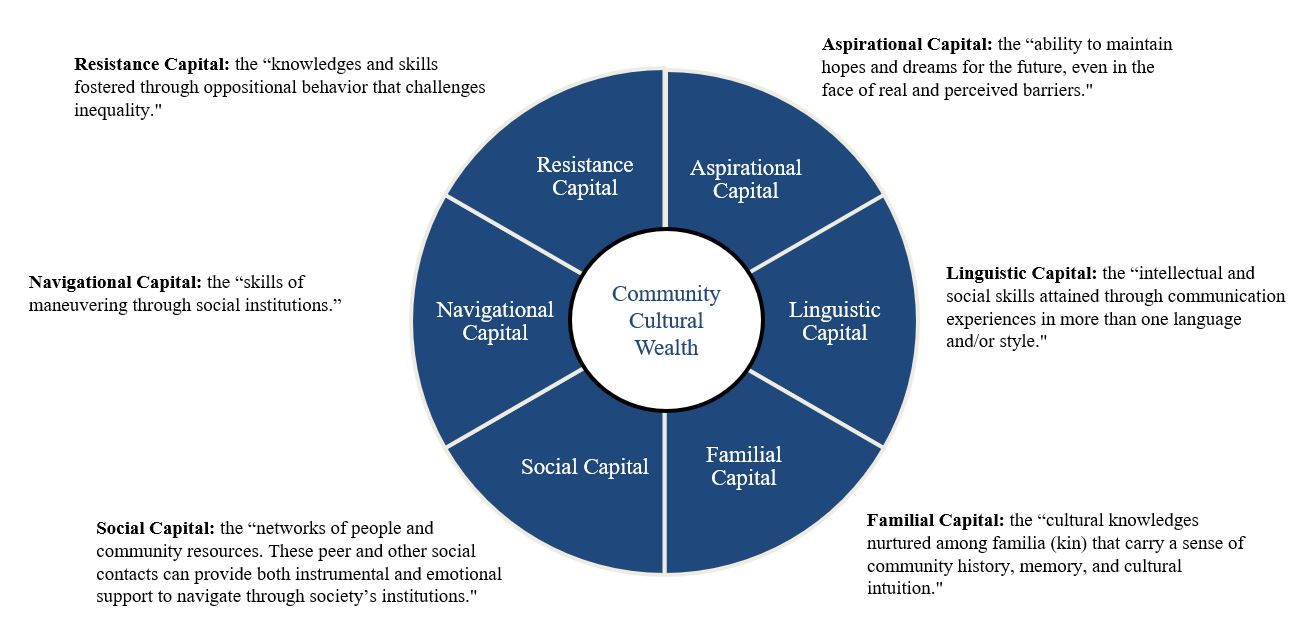
This activity is meant to have you reflect on your community cultural wealth and explore how its cultural capital has helped you navigate a college environment. Community cultural wealth is an assets-based framework that focuses on identifying the cultural capital that students acquire in their families and communities that can help them navigate through a college environment. This framework, developed by Tara Yosso, identified six sources of cultural capital that come together to form community cultural wealth. These are aspirational capital, linguistic capital, familial capital, social capital, navigational capital, and resistance capital. To complete this activity, you will first read the definitions of the six sources of cultural capital identified by Yosso provided in the chart below and reflect on how they have helped you navigate the college environment. When you finish this reflection, you will transfer your thoughts to a Google form. The form is anonymous, and it will not ask for your name. Sharing this information allows for your voice to be heard and can influence how the curriculum can be structured or redefined to be inclusive of your community cultural wealth.