| LEARNING OBJECTIVES 1. Explain the impact that brain and language evolution has had on the development of the human species. 2. Explain why Homo sapiens is referred to as a cultural species and how humans have come to populate the world. 3. Identify the factors that gave rise to religion and some the characteristics that defined early religion during the Paleolithic Era. View Timelines: Prehistory | Evolution |
DEEP HISTORY
Before we begin this topic, I wanted to introduce you to an area of specialization within the field of history known as deep history. What is it exactly? Deep history is a way of studying the human past that goes much further back than traditional history. Instead of starting with written records a few thousand years ago, deep history looks at the entire span of human existence, including prehistoric times using evidence from archaeology, anthropology, biology, and environmental science and other fields. In other words, it places humans within deep time rather than just the recent past. The key idea behind deep history for us is that to really understand what it means to be human, we can’t just look at civilizations, governments, or written documents. We also have to look at human evolution, early societies, and long-term interactions with the environment. For example, deep history explores how early humans developed language, social cooperation, tool use, and even emotional behaviors. These long-term developments help explain patterns we still see today, like social bonding or inequality. Ultimately, deep history helps us see that being human is not just about recent societies, it’s the result of long-term biological, cultural, environmental, and technological processes. It expands our perspective, showing that many aspects of human life today have roots that go back far deeper than we usually imagine. Much of what follows in this presentation is a product of deep history and the gains scholars have made from the chronometric revolution. One more thing, for this section when I reference humans, I mean Homo sapiens,
Table 1: Deep History and What It Tells Us About Being Human
| Area of Human Life | What Deep History Shows | What This Means About Being Human Today |
|---|---|---|
| Social Behavior | Early humans survived through cooperation, group living, and social bonds | Humans are deeply social; relationships and communities are essential, not optional |
| Culture | Culture (language, tools, traditions) developed gradually and was passed down over generations | Culture is a core part of being human—we learn how to live from others |
| Environment | Humans have always adapted to changing environments (ice ages, migrations, resource shifts) | Our lives today are still shaped by environmental conditions and challenges like climate change |
| Technology | Tool use began millions of years ago and continuously evolved | Technology is not new—it’s a fundamental part of human survival and identity |
| Biology & Brain | Human brains and bodies evolved alongside social and environmental pressures | How we think and feel is partly shaped by long-term evolutionary processes |
| Inequality & Power | Social hierarchies emerged over time with agriculture and complex societies | Inequality is not “natural” it developed historically and can change |
| Adaptation & Flexibility | Humans have constantly adapted to new challenges and environments | Being human means being flexible and capable of change |
| Time Perspective | Human history stretches far beyond written records into “deep time” | Our current way of life is just a small moment in a much longer story |
| Human–Environment Relationship | Humans have always shaped and been shaped by nature | We are part of ecosystems, not separate from them |
| Innovation | Humans have consistently created new ways to solve problems | Creativity and problem-solving are defining human traits |
THE COGNITIVE REVOLUTION
One of the most important leaps forward in human evolution was the development of advanced cognition and referred to in academia as the cognitive revolution. So, what specifically is this revolution? The cognitive revolution refers to a major shift in how humans thought and understood the world. It seems to have taken place roughly between 70,000 and 50,000 years ago, though scholars still debate the exact dating. Before the cognitive revolution, earlier human species could use tools and survive in their environments, but their thinking is believed to have been more immediate and tied to the present. What changed with Homo sapiens was the development of symbolic thought, the ability to use language, images, and objects to represent things. This is why we start to see cave art, jewelry, rituals, and more complex tools in the archaeological record.
Table 2: Hominins and the Cognitive Revolution
| Hominin Species | Did They Experience the Cognitive Revolution? | Explanation |
|---|---|---|
| Homo sapiens | Yes (fully developed) | Around 70,000–50,000 years ago, Homo sapiens developed advanced language, symbolic thinking, art, and complex social structures—key features of the cognitive revolution. |
| Homo neanderthalensis | Partially / debated | Neanderthals showed signs of symbolic behavior (burials, tools), but not at the same level of complexity or innovation as Homo sapiens. |
| Homo erectus | No (pre-cognitive revolution) | Had important developments like tool use and fire, but lacked advanced symbolic thought and language. |
| Homo habilis | No | Early tool use but very limited cognitive complexity compared to later species. |
| Australopithecus | No | Primarily bipedal but lacked advanced cognitive abilities. |
As a result of the cognitive revolution, humans could begin to reflect on themselves, remember the past in a structured way, and imagine the future. This ability is referred to as the narrative self, where identity is not just about being alive in the moment, but about having a past, present, and future that are connected. It also meant that identity became more social. As language improved, humans could share beliefs, create traditions, and form group identities based on shared symbols like rituals or myths.
Table 3: Implications of the Cognitive Revolution on Early Homo sapiens
| Domain | Cognitive Change (Leap Forward) | Implications for Early Homo sapiens |
|---|---|---|
| Language & Communication | Development of symbolic and syntactic language | Enabled precise communication, storytelling, and transmission of complex ideas across generations |
| Social Cooperation | Emergence of shared intentionality and collective understanding | Allowed large-scale cooperation beyond kin groups, forming tribes and alliances |
| Symbolic Thinking | Ability to use symbols (art, ornaments, rituals) | Created shared meanings, identities, and cultural cohesion |
| Cultural Transmission | Development of cumulative culture | Knowledge could accumulate and improve over generations (tools, strategies, norms) |
| Abstract Thought | Capacity for imagination and hypothetical reasoning | Enabled planning, innovation, and creation of myths or belief systems |
| Technology & Innovation | Improved problem-solving and foresight | More sophisticated tools, hunting strategies, and environmental adaptation |
| Group Identity & Religion | Creation of shared myths and belief systems | Strengthened group cohesion and cooperation among strangers |
| Art & Expression | Development of visual art, music, and rituals | Reinforced social bonds and communication of abstract ideas |
| Ecological Impact | Strategic hunting and environmental manipulation | Rapid expansion across continents and dominance over ecosystems |
Humans also became capable of creating and believing in things that don’t physically exist, such as gods and social rules. These shared ideas allowed large groups of Homo sapiens to cooperate in complex ways never seen before. The end result would be us in the present.
BRAIN AND LANGUAGE EVOLUTION
In studying the deep history of early humans, archaeologist Clive Gamble points out that two major patterns define our past. these are the growth of the brain (encephalization) and the spread of humans across the globe. Encephalization, the increase in brain size relative to body size, was a turning point in human evolution because it gave humans the ability to think in more complex and abstract ways. No encephalization, no cognitive revolution. This is what allowed humans to become, as Robert Boyd puts it, a different kind of animal. Instead of relying only on instinct or slow biological changes, humans developed culture and language, which became the drivers of our success. Boyd explains that humans survive in many environments not just through individual intelligence, but through cumulative culture, where each generation builds on the knowledge of the previous one.
These ideas help explain how closely human biology and social behavior are connected. Our larger brains made language possible, and language allowed us to communicate using symbols and share ideas far beyond basic survival needs. Over time, this led to the development of culture which transmits across generations shared traditions, tools, beliefs, and social rules. What makes humans unique is how these elements work together. Our brains make language possible, language spreads culture, and culture, in turn, shapes how our brains develop and how we think. In other words, being human is not just about having a big brain, but also about how that brain interacts with language and culture to create meaning and shared ways of life.
New discoveries in archaeology, linguistics, geology, and genetics have helped us better understand this process. They show how humans went from small, scattered groups to a species that could live almost anywhere on Earth. Again, a key part of this transformation was cognitive evolution and the development of language, which became one of humanity’s most powerful tools. Language allowed people to store and share knowledge over time, making it possible to adapt quickly to new environments like deserts, forests, and icy tundras. This ability to adapt culturally led to the global spread of humans and marked a major turning point in the history of life.
Together, encephalization and language make culture possible by allowing knowledge to be preserved and expanded across generations. As a result, humans are able to develop complex societies, technologies, and belief systems that endure over time. In this way, encephalization serves as the biological foundation, while language acts as the system that turns that potential into meaningful human behavior and shared ways of life. Together, encephalization and language turn individual intelligence into collective power, allowing humans to build societies, transform environments, and continuously advance technology in ways no other species can. This constant ability to adapt, learn, and innovate is what has allowed our species to grow, spread, and reshape the planet. It has also facilitated the complex urban world you live in today, Los Angeles.
Table 4: How Encephalization and Language Shape Society, Environment, and Technology
| Area | Role of Encephalization (Brain Growth) | Role of Language | Resulting Human Impact |
|---|---|---|---|
| Society | Enables complex thinking, social awareness, and understanding of relationships | Allows communication of ideas, rules, and shared meanings | Creation of large, organized societies with governments, laws, and institutions |
| Environment | Supports problem-solving and adaptability to different conditions | Spreads knowledge about survival strategies (e.g., farming, shelter, tools) | Humans adapt quickly to diverse environments and can reshape ecosystems |
| Technology | Enables planning, creativity, and innovation | Allows teaching, sharing, and improving techniques across generations | Development of increasingly complex tools, from stone tools to modern technology |
THE ORIGIN OF HUMAN LANGUAGE
The origin of language, something uniquely human, must therefore be explored through the lens of brain evolution. But the brain does not act alone. Its organization is intricately linked to the human vocal apparatus which include the lungs, tongue, teeth, nasal passages, and other structures that enable the production of speech. Together, these components make possible the extraordinary “transformation between acoustic waveform and thought,” allowing humans to convey abstract ideas, emotions, and complex information.
Why did language evolve so quickly in modern humans? Recent discoveries in genetics may hold the key to answering this question, particularly the role of a gene known as FOXP2. This gene provides instructions for making “a protein called forkhead box P2 . . . [which] . . . appears to be essential for the normal development of speech and language.” While FOXP2 is not unique to humans, molecular biologists have discovered two key differences in the human version of this gene compared to that of chimpanzees. The proteins encoded by human and chimpanzee FOXP2 differ by just two amino acid substitutions, but these small changes likely enhanced the gene’s function, fine-tuning humans’ ability to produce and process speech.
Additionally, patterns of variation in the FOXP2 gene in human populations suggest that these changes underwent Darwinian selection within the past 200,000 years, a period corresponding to the emergence of anatomically modern humans. This strong selective pressure implies that these genetic changes conferred a significant adaptive advantage, likely improving communication and social coordination. The discovery of FOXP2 offers an essential piece of the puzzle in understanding how language, one of humanity’s most defining traits, evolved so rapidly and shaped the success of our species.
CULTURE, LANGUAGE AND HUMAN INNOVATION
It is important to recognize that “evolution did not create symbols or grammar . . . [but] . . . human creativity and intelligence did.” For this reason, the quest for the origins of human language must account for both the cognitive capacities provided by evolution and the cultural invention of language. Evolution equipped the human brain with the ability to think abstractly, solve problems, and innovate, but it was humans who transformed those capacities into realities. So, what exactly is language? According to linguist Daniel Everett, “Language is the interaction of meaning (semantics), sentence structure (syntax), sound properties (phonetics and phonology), cultural conditions on usage (pragmatics and discourse), and gestures.” While all animals communicate, Everett’s definition highlights the extraordinary complexity and cultural foundation of human language.
Language is believed to have evolved from culturally invented symbols. Everett argues that “Language gradually emerged from a culture, formed by people who communicated with one another via human brains.” This process relied on what Everett describes as a synergy between grammar, symbols, and culture, each shaping and reinforcing the other. Language became the mechanism for transmitting knowledge and facilitating collective learning, allowing humans to preserve, refine, and share their accumulated knowledge across generations. This extraordinary ability enabled humans not only to adapt to new environments but also to innovate and thrive in ways no other species could. Language, then, is more than a means of communication. It is the foundation of human progress and the key to our success as a species.

In the following excerpt, evolutionary biologist Mark Pagel, renowned for his work on the evolution of communication, explores the extraordinary nature of human language. He delves into what language is, how it shapes our lives, and when it might have originated. By examining the roots of this uniquely human trait, Pagel provides valuable insight into the defining features of our species and the pivotal role language plays in our success.
| “Human language is distinct from all other known animal forms of communication in being compositional. Human language allows speakers to express thoughts in sentences comprising subjects, verbs and objects—such as ‘I kicked the ball’—and recognizing past, present and future tenses. Compositionality gives human language an endless capacity for generating new sentences as speakers combine and recombine sets of words into their subject, verb and object roles. For instance, with just 25 different words for each role, it is already possible to generate over 15,000 distinct sentences. Human language is also referential, meaning speakers use it to exchange specific information with each other about people or objects and their locations or actions. No one knows for sure when language evolved, but fossil and genetic data suggest that humanity can probably trace its ancestry back to populations of anatomically modern Homo sapiens (people who would have looked like you and me) who lived around 150,000 to 200,000 years ago in eastern or perhaps southern Africa [4,5,6]. Because all human groups have language, language itself, or at least the capacity for it, is probably at least 150,000 to 200,000 years old. This conclusion is backed up by evidence of abstract and symbolic behaviour in these early modern humans, taking the form of engravings on red-ochre.” – Mark Pagel |
The evolution of the human brain and the development of language “enabled humans to store considerable amounts of information on an unprecedented scale with great adaptive potential,” transforming our species into exceptional problem-solvers. This combination of cognitive abilities and cultural innovation allowed humans to adapt to new environments far more quickly than adaptation by natural selection, which relies on genetic changes over vast timescales. Equipped with these unique traits, humans were no longer bound by the slow pace of genetic evolution. Instead, language and culture became the tools through which they could share knowledge, solve problems, and innovate, enabling rapid adaptation to diverse ecosystems.
This ability had profound implications for human history. It allowed humans to spread across the globe, from the grasslands of Africa to the frozen tundras of Siberia and beyond, a process known as extensification. Unlike other species, humans didn’t just survive in new environments, they thrived by shaping their surroundings to meet their needs. This adaptability laid the foundation for agriculture, urban societies, trade networks, and the transmission of knowledge across generations. By combining biological evolution with cultural creativity, humans transcended the limitations of other species, becoming not just survivors but world-builders.
HUMAN CULTURE
What is culture? Culture is defined by many as information that is shared and acquired from other individuals through social transmission. Alex Mesoudi notes that humans are a cultural species in that “we acquire a multitude of beliefs, attitudes, preferences, knowledge, skills, customs, and norms from other members of our species culturally, through social learning processes such as imitation, teaching, and language.” Similarly, Steven J. Mithen emphasizes that “Cultural behavior derives from our capacity for learning, decision making, and problem-solving.” Culture shapes how humans interact with one another and the world, providing the framework for social structures, traditions, and innovations. Language is what makes humans a cultural species, as it allows us to transmit knowledge, beliefs, and practices across generations, fostering collective learning.
But is there a relationship between culture and human evolution? And when do the earliest examples of culture appear in human history? These are challenging questions, but some scholars believe the answers lie in a series of caves on the southern tip of Africa. One of the most fascinating examples comes from Blombos Cave, where artifacts dating back to approximately 70,000 B.C.E. provide some of the earliest evidence of material culture. Among these artifacts are engraved ochre pieces and shell beads, which suggest the presence of symbolic thought, social behaviors, and creativity. These tangible creations, what anthropologists call material culture, represent the earliest known attempts to create and share meaning within a community, offering a glimpse into the origins of human culture itself.
Culture “is a compendium of useful innovations that are preserved because individuals appreciate their value.” This ability to create, share, and adapt innovations to different environments is what has made our species so successful. But an intriguing question arises. Did human language and intelligence evolve primarily to enhance our foraging skills, or were they shaped by the need to build social networks that fostered collaboration and innovation? For archaeologist John Gowlett, the answer lies in both. He emphasizes what he calls the “eternal triangle” of human evolution, with its three points being diet change, detailed environmental knowledge, and social collaboration. These factors, Gowlett argues, are deeply interconnected. For example, shifts in diet required knowledge of the environment to locate resources, while social collaboration allowed humans to hunt, gather, and share food in ways no other species could match.
This interplay of biology, culture, and environment raises another critical question. Should we focus solely on evolution to explain humanity’s ecological success? In the following excerpt, Robert Boyd challenges this perspective, inviting us to consider how culture and social learning shaped our unique trajectory:
| “Most accounts of human evolution explain our ecological success as the result of superior cognitive abilities. While it is probable that individual humans are smarter than other animals, we do not think this is the most important cause of our success. Think about what people have to know to survive and prosper in just one habitat where human foragers have flourished, the North American Arctic. They have to know how to make dozens of essential tools—kayaks, warm clothing, toggle harpoons, oil lamps, shelters built of skin and snow, goggles to prevent snow blindness, dog sleds and the tools to make these tools. They also have to know how to use all of this stuff, where and when to hunt and gather, what to seek, how to process it if you succeed, and so on and on. Then they have to decide how to organize their society: how to regulate exchange of resources, how to organize marriage, resolve conflicts and so on and on. If individual intelligence were the key, individuals could create all of this knowledge on their own.” |
HUMAN EXTENSIFICATION
Early human migration and the population of the world, a process referred to as extensification, was made possible by humans’ extraordinary cognitive abilities, language, and collective learning (culture). Extensification allowed humans to spread across the globe at a startling rate, adapting to new environments without relying solely on the slow mechanisms of evolutionary change. This topic has been explored by the historian and environmentalist Kirkpatrick Sale through a fascinating hypothesis. Sale contends that around 70,000 years ago, humans developed a hunting and gathering culture that was shaped by climatic changes and the resulting scarcity of food. The quest for resources necessary for survival fueled new patterns of migration, as groups sought out environments where they could thrive. Sale argues that this migration, combined with the hunting and gathering culture, fundamentally altered humanity’s relationship with the biosphere. Humans evolved into what he describes as a species of domination, one that “allowed it to stand distanced from the world so that it was able to expand its control and dominion in a totally unprecedented way, justified in the name of survival.”
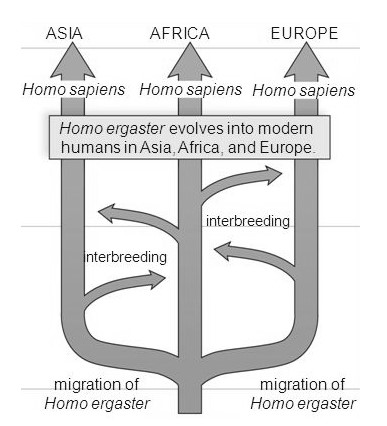
Human migration was influenced by both cultural developments and environmental challenges, but scientists have proposed different explanations for how humans physically spread across the globe. One important theory is the multiregional continuity model, developed by Milford Wolpoff and Alan Thorne. This model suggests that modern humans evolved over the past million years in multiple regions of Africa, Europe, and Asia from earlier populations of Homo ergaster. According to this view, populations in different areas remained connected through gene flow and all contributed to the development of modern human diversity. Support for this model mainly comes from fossil evidence and morphological similarities, which help explain regional differences among human populations today.
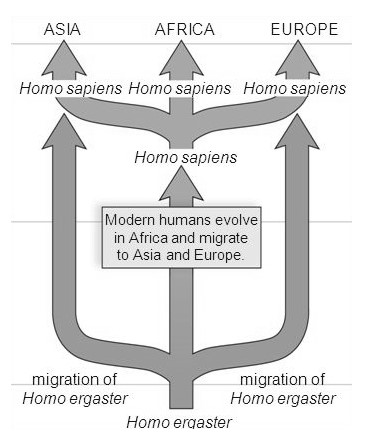
A second hypothesis is the Out-of-Africa model, which argues that all modern humans descended from a few common ancestors who lived approximately 250,000 years ago in Africa. This hypothesis is strongly supported by genetic evidence: comparisons of present-day human DNA reveal less genetic diversity in populations outside Africa, suggesting they originated from a smaller group of migrants who left the continent. However, a lingering mystery is why humans migrated out of Africa around 60,000 years ago. Scholars propose several possible factors, including drought caused by climatic changes, the development of new technologies, improved nutrition, or even a genetic mutation that enhanced cognitive or physical abilities.
Let’s take a closer look as to how genetic evidence helps historians. The geneticist David Reich explains that,
| “Each of us has two genomes: one from our mother, one from our father. Some segments are more alike than others. The more differences, or mutations in a given segment, the longer it’s been since the gene copies bequeathed to us by our parents shared a common ancestor. These mutations tell us how closely related two people are and record exquisitely precise information about the past.” |
Mutations, small changes in DNA that accumulate over generations, serve as a kind of molecular clock, allowing scientists to trace relationships between individuals and populations. This genetic record offers a powerful tool for reconstructing the movements and interactions of ancient human populations, helping to illuminate the story of human evolution with remarkable precision.
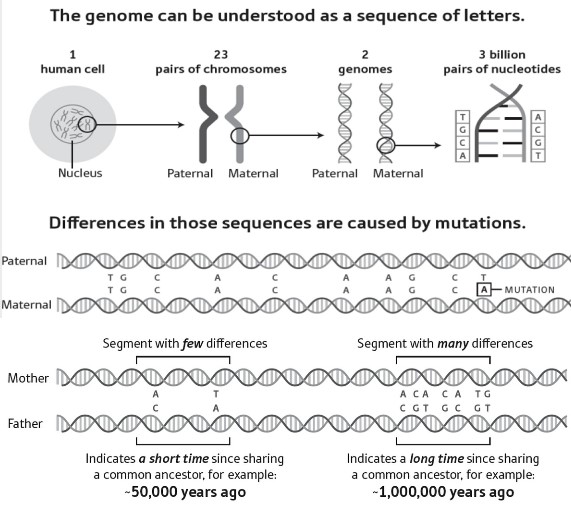
The image above explains how human DNA works and how scientists use it to understand relationships between people and human evolution. At the top, it shows that every human cell contains a nucleus with 23 pairs of chromosomes (half inherited from the mother and half from the father) which together make up our genome. This genome is like a long sequence of “letters” (A, T, C, G) that form DNA. The diagram then shows that differences in these sequences come from mutations, which are small changes in the DNA over time. By comparing DNA sequences between individuals, scientists can see how closely related they are: if two sequences have only a few differences, it means they share a recent common ancestor (like tens of thousands of years ago), while many differences suggest a much older shared ancestor (hundreds of thousands or even millions of years ago).
Table 5: Comparison of Human Extensification Models
| Category | Multiregional Continuity Model | Out-of-Africa Model |
|---|---|---|
| Basic Idea | Modern humans evolved in multiple regions from earlier populations of Homo erectus. | Modern humans evolved in one location (Africa) and later spread outward. |
| Origin of Homo sapiens | Emerged simultaneously in different regions across the Old World. | Emerged in a single place, most likely Africa (including nearby regions like the Middle East). |
| Role of Homo erectus | All modern humans evolved from Homo erectus populations that spread out of Africa. | Homo erectus left Africa, but modern humans evolved later in Africa and replaced them. |
| Gene Flow Between Populations | Continuous gene flow between populations prevented them from becoming separate species. | Populations became reproductively isolated, evolving separately (e.g., Neanderthals). |
| Human Variation (Race) | Regional differences developed over time due to local natural selection. | Human variation is recent and developed after migration out of Africa. |
| Speciation (New Species Formation) | No full speciation occurred due to ongoing interbreeding across regions. | Some populations evolved into separate species (e.g., Neanderthals). |
| Migration Pattern | Early humans spread out, and evolution happened in place across regions. | Humans originated in Africa and migrated outward, replacing other populations. |
| Interbreeding | Yes – populations remained connected through gene flow. | No (original model) – modern humans replaced others without interbreeding. |
| Primary Evidence Used | Relies heavily on morphological evidence (physical traits in fossils across regions). | Relies heavily on genetic evidence (DNA studies showing a common African origin). |
| View of Human Evolution | Evolution is regional but connected. | Evolution is single-origin followed by global expansion. |
In addition to evolutionary theories, environmental events may have played a major role in human migration. For example, the massive eruption of Mount Toba around 71,000 B.C.E., far more powerful than Mount Saint Helens, released enormous amounts of debris into the atmosphere and caused dramatic global cooling. This environmental crisis may have led to food shortages in Africa, pushing human groups to migrate in search of more favorable conditions. Whether driven by environmental pressures or human adaptability and innovation, these migrations represent a crucial stage in human history, highlighting the resilience and flexibility of our species.
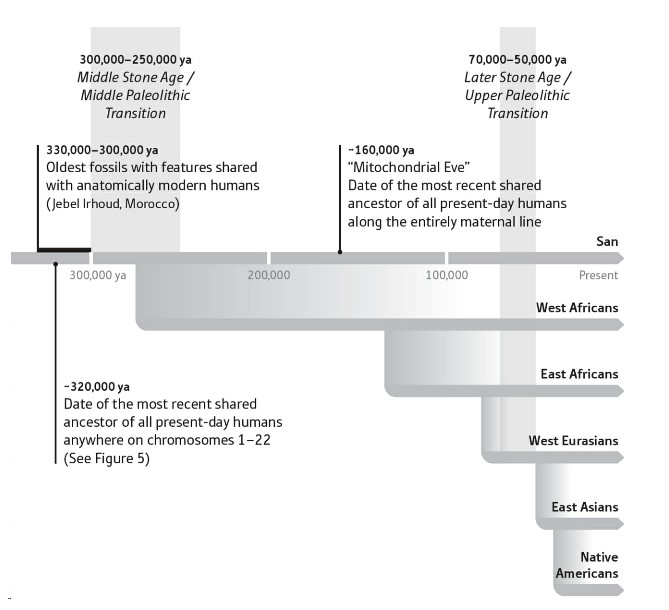
The image above is a timeline that shows how modern humans evolved and spread across the world based on genetic and fossil evidence. It begins around 300,000 years ago with some of the earliest fossils of anatomically modern humans found in Africa (like those from Jebel Irhoud, Morocco). The diagram then highlights key genetic milestones, such as the “mitochondrial Eve” (about 160,000 years ago), who represents the most recent common maternal ancestor of all living humans. As time moves forward, the lines branch out to show different human populations (such as West Africans, East Africans, Eurasians, East Asians, and Native Americans) indicating how groups migrated out of Africa and diversified. The length and branching of these lines represent how populations split and how long ago they shared common ancestors. Overall, the image demonstrates that all modern humans share a common origin in Africa and that genetic differences today developed gradually as groups migrated and adapted to different environments over time.
Through genetics, we not only gain insight into the origins of our species but also into the shared biological heritage that unites us all. This transformative field has underscored the extraordinary adaptability and diversity of humans while reminding us of the common thread that links all of humanity to a single African origin.
HUMANS IN THE PALEOLITHIC ERA
As humans migrated out of Africa, their ingenuity and adaptability allowed them to thrive in new and often challenging environments. This phase of human globalization took place during the Paleolithic Age (2.5 million years ago–12,000 B.C.E.), the first and longest era in human history. Reconstructing human life during the Paleolithic Era is a challenging task, as writing had not yet been developed. However, scholars have drawn valuable insights by studying the archaeological record and present-day hunting and foraging societies. For example, excavations of Paleolithic sites have uncovered stone tools, which played a crucial role in human survival. These tools allowed early humans to process a wide range of foods, including plants, nuts, and meat, and provided a critical advantage in adapting to diverse environments.
Table 6: Comparison of Prehistoric Periods
| Category | Paleolithic (Old Stone Age) | Mesolithic (Middle Stone Age) | Neolithic (New Stone Age) |
|---|---|---|---|
| Time Period | ~2.6 million – 10,000 BCE | ~10,000 – 8,000 BCE (varies by region) | ~10,000 – 3,000 BCE (varies by region) |
| Human Species | Early hominins (Homo habilis, Homo erectus), later Homo sapiens, Neanderthals | Mostly Homo sapiens | Homo sapiens only |
| Lifestyle | Nomadic hunter-gatherers | Semi-nomadic; seasonal camps | Settled farming communities |
| Tools | Simple stone tools (Oldowan, Acheulean), later more refined tools | Smaller, more precise tools (microliths) | Advanced tools (polished stone, sickles, axes) |
| Food Sources | Hunting animals, gathering plants | Hunting, fishing, gathering | Farming (crops) and domesticated animals |
| Technology & Innovation | Fire use, early tools, cave art | Fishing tools, bows and arrows, improved tools | Agriculture, pottery, weaving, permanent houses |
| Social Organization | Small bands, kin-based groups | Larger groups, more social complexity | Villages, early social hierarchy |
| Art & Culture | Cave paintings, carvings, symbolic behavior | More portable art, decorative objects | Pottery, sculptures, religious structures |
| Archaeological Sites | Olduvai Gorge (Tanzania), Lascaux Cave (France), Altamira (Spain), Zhoukoudian (China) | Star Carr (England), Mount Sandel (Ireland), Lepenski Vir (Serbia) | Jericho (Palestine), Çatalhöyük (Turkey), Stonehenge (England) |
| Housing | Caves, temporary shelters | Seasonal huts, tents | Permanent houses (mudbrick, stone) |
| Key Developments | Human evolution, tool-making begins | Transition period after Ice Age, adaptation to new environments | Agricultural Revolution (“Neolithic Revolution”) |
| Population Size | Very small, scattered groups | Increasing population | Larger, more dense populations |
| Environment | Ice Age conditions, changing climates | Post-Ice Age warming | Stable climates supporting agriculture |
From these findings, scholars have inferred that Paleolithic humans lived in small, mobile bands, relying on cooperative hunting and foraging to subsist. Their technological innovations, combined with accumulated knowledge about local ecosystems, enabled them to spread across the globe and establish a foundation for the development of human culture.
From about 35,000 B.C.E., technological innovations continued to drive human survival and expand their colonization efforts. Early humans began crafting tools from materials other than stone, such as bones, ivory, and antlers, using them to create harpoons, fish hooks, and other specialized implements. The advent of projectile technology, including the bow and arrow, spear, and spear thrower, revolutionized hunting practices and increased the efficiency of resource acquisition. These advancements not only ensured human survival but also created opportunities for reflective thinking, the capacity to contemplate existence, the environment, and the unseen forces shaping life.
Evidence of this reflective thought can be found in the remarkable cave paintings of Altamira (Spain), Chauvet-Pont-d’Arc, and Lascaux (France), where early humans depicted animals and symbols with stunning artistry and precision. These paintings likely held spiritual or symbolic significance, serving as a means of communication or ritual. Reflective thinking is also evident in burial practices, which suggest a belief in an afterlife or reverence for the dead, and in objects of worship such as Venus figurines. These figurines, often depicting exaggerated female forms, are thought to represent fertility goddesses, highlighting an early awareness of reproduction’s role in human survival. Together, these artifacts provide a glimpse into the developing symbolic and spiritual life of early humans, marking the Paleolithic period as a transformative era in human history.
Paleolithic societies exploited a diverse array of plants and animals to meet their dietary needs. Specialists like Marshall Sahlins, in his work The Original Affluent Society, argue that these societies more than adequately met their daily caloric requirements through varied and sustainable diets. Hunting and foraging allowed these communities to maintain a strategic and systematic pattern of movement, following animal migrations and plant cycles with precision. This mobility discouraged the accumulation of private property, as constant movement made it impractical, and instead fostered semi-egalitarian social structures. Both men and women contributed equally to the survival of the community, with men often focusing on hunting and women specializing in foraging, though roles likely overlapped depending on the environment and group needs.
Knowledge sharing was central to these societies, as collective survival relied on passing down information about resources, seasonal cycles, and environmental conditions. This shared knowledge reinforced the sense of communal responsibility and cooperation that defined Paleolithic life. The semi-egalitarian nature of these communities—rooted in shared resources and a lack of wealth accumulation—stood in stark contrast to the hierarchical structures that would later emerge with the rise of agriculture and sedentary life.
Wherever humans went, they left a lasting impact on the environment they encountered. One striking example is the extinction of large animals, such as mammoths and giant ground sloths, which coincided with human colonization. These extinctions are believed to have resulted from overhunting or habitat changes caused by human activity, though climatic shifts may have also contributed. Humans also used fire-stick farming, a technique that involved setting controlled fires to clear vegetation, encourage the growth of fresh plants, and attract grazing animals. This practice not only reshaped local ecosystems but also ensured a steady supply of resources for hunting and foraging.
The subsistence strategies of Paleolithic societies, rooted in hunting and foraging, profoundly influenced their social organization and population density. Small, mobile bands of 15 to 50 members were the norm, allowing groups to adapt to seasonal resource availability and maintain ecological balance. Kinship, or blood relationships, served as the primary organizing principle in these bands, fostering cooperation and shared responsibility for survival. Together, these practices highlight the dynamic relationship between humans and their environment, where ecological changes and social structures were deeply intertwined.
THE ORIGINS OF RELIGION
Religion, a vital facet of culture, has played an instrumental role in shaping the course of human history. It has guided human behavior, provided meaning and purpose, and influenced the development of social and political systems across civilizations. For this reason, religion is one of the central themes we will focus on throughout this course. As we begin to explore the origins of religion, I would like you to reflect on the following two quotes. These insights will help frame our discussion, offering contrasting perspectives on the nature and purpose of religion and its role in shaping humanity.
| “Most people have a clear idea of what they mean by religion and can usually identify religious behavior when they see it. Nevertheless, when we have to define religion, we soon discover that the task is quite difficult, because religion is manifested in many different ways in our world.” – Irving Hexam “If we want to go on talking about ancient Mesopotamian religion, ancient Greek religion, or any other ancient religion, we should always bear in mind that we are talking about something modern when we do so. We are not naming something any ancient person would recognize. In our current context, we organize our contemporary world using the concepts of religious and secular.” – Brent Nongbri |
Rather than attempting to define religion, it may be more insightful to explore the characteristics that make up this complex and multifaceted concept. Religion takes many forms across cultures, and focusing on its characteristics allows us to identify commonalities while appreciating its diversity. To begin this exploration, consider the two tables below. Take a moment to examine their characteristics, noting where they overlap and where they diverge. This exercise will help illuminate the universal elements of religion as well as the unique perspectives each model offers on this enduring human phenomenon.
Table 7: Bruce Lincoln’s Model of Religion
(Focuses on how religion is constructed through social processes)
| Element | Description | Key Idea |
|---|---|---|
| Discourse | Refers to religious ideas, beliefs, and claims about transcendent or sacred matters | Religion begins with shared beliefs and meanings |
| Practices | Actions and rituals that put beliefs into practice | Religion is expressed through what people do |
| Community | Group of people who share and identify with the religion | Religion creates group identity and belonging |
| Institution | Organized structures that regulate beliefs and practices | Religion becomes formalized and structured |
Table 8: Ninian Smart’s Model of Religion
(Focuses on the different dimensions or aspects of religion)
| Dimension | Description | Example |
|---|---|---|
| Doctrinal | Core beliefs and teachings of a religion | Belief systems, theology |
| Mythological | Stories and narratives that explain origins and meaning | Creation stories, legends |
| Ethical | Rules and moral guidelines for behavior | Laws, moral codes |
| Rituals | Formal practices and ceremonies (public or private) | Prayer, ceremonies |
| Experiential | Personal religious experiences and emotions | Feelings of awe, spiritual encounters |
| Institutional | Organized religious communities and leadership | Churches, priesthoods |
| Material | Physical objects, symbols, and sacred spaces | Temples, artifacts, sacred texts |
Currently, no single persuasive general theory exists to explain the origins of religion. Earlier efforts proposed that religion arose because it comforts humans or serves social purposes, such as fostering cohesion and order. More recently, cognitive theories have reframed religion as a product of mental processes like perception, memory, and reasoning. This perspective suggests that religion helps humans interpret and influence the world by projecting humanlike qualities onto the unknown—a strategy known as anthropomorphism. Because humans understand humanity best, they attribute human characteristics to animals, gods, or objects to make sense of the unfamiliar and unpredictable.
Although we will likely never pinpoint the birth of the first religious idea, a substantial body of evidence suggests that cultural artifacts, art, and burial practices of the Upper Paleolithic (c. 50,000–10,000 B.C.E.) reflect early religious sentiments. Upper Paleolithic Homo sapiens, being anatomically and cognitively modern, had the capacity to create religion, making it plausible that religious systems emerged during this period. Early religions likely linked symbolic environmental information to social behaviors, guiding group actions and fostering cohesion. However, given the egalitarian and mobile nature of hunter-gatherer societies, religious beliefs were fewer in number and transmitted through ritual performances rather than scripture. Rituals played a central role in these early religions, as they reinforced social bonds, fostered solidarity, and strengthened group cohesion without centralized authority. Consequently, ritual-based religions likely dominated this transformative period in human history.
Table 9: Factors in the Creation of Religion
| Category | Facilitating Factors (Make Religion Possible) | Stimulating Factors (Drive the Need for Religion) |
|---|---|---|
| Cognitive Ability | Development of abstract thinking and symbolic reasoning in humans | Curiosity about existence, meaning, and the unknown |
| Language & Communication | Ability to share ideas, stories, and beliefs across groups | Desire to explain complex ideas like creation, death, and the universe |
| Social Organization | Formation of groups and communities that can share rituals | Need for social cohesion, unity, and shared identity |
| Cultural Development | Creation of traditions, symbols, and shared meanings | Desire to preserve knowledge and pass beliefs across generations |
| Imagination & Symbolism | Ability to imagine unseen forces, spirits, or deities | Fear of unseen forces (spirits, nature, death) |
| Memory & Learning | Ability to remember and transmit rituals and myths | Need to make sense of past events and experiences |
| Environmental Awareness | Close interaction with nature and surroundings | Need to explain natural phenomena (storms, seasons, disasters) |
| Emotional Capacity | Ability to feel empathy, fear, hope, and awe | Fear of death and desire for an afterlife or comfort |
| Tool Use & Ritual Behavior | Development of repeated, symbolic actions (rituals) | Need for control or influence over uncertain outcomes (hunting, survival) |
| Time Awareness | Understanding of past, present, and future | Concern about mortality and what happens after death |
Recent reconstructions of early religion by scholars suggest a rich tapestry of beliefs, including animism, ancestor worship, shamanism, and concepts of an afterlife. Animism, the belief that objects, animals, and natural phenomena possess spiritual essence, likely shaped early humans’ connection to the world around them. Ancestor worship emphasized reverence for the dead, linking communities to their past and fostering social cohesion. Shamanism involved individuals acting as mediators between the human and spiritual realms, guiding rituals and practices. Finally, the concept of an afterlife reflects early beliefs about existence beyond death, providing meaning and comfort in the face of mortality.
It is generally agreed that “the oldest trait of religion was animism . . . which enables people to attribute intent and lifelike qualities to inanimate objects and would have prompted belief in beings or forces in an unseen realm of spirits.” In small-scale societies, animism provided a framework for understanding the natural world and addressing the unknown. However, as humans transitioned from small-scale to large-scale societies, religion also evolved to meet new social challenges. With the aid of the written record, it becomes clear that “supernatural agents become increasingly morally concerned, more effective at monitoring norm violations (omniscience) and better equipped to provide punishment and rewards (heaven and hell) according to prescribed behavior.”
Table 10: Early Religious Beliefs in the Paleolithic Era
| Belief/Practice | Description | Evidence/Examples | Meaning/Significance |
|---|---|---|---|
| Animism | Belief that animals, plants, and natural objects have spirits or life forces | Cave art showing animals with symbolic importance (Lascaux, France; Altamira, Spain) | Suggests humans saw themselves as spiritually connected to nature |
| Shamanism | Spiritual leaders (shamans) communicated with the spirit world, often through rituals or trance states | Cave paintings interpreted as trance visions (Chauvet Cave, France) | Indicates early religious specialists and ritual practices |
| Ancestor Worship | Respect or spiritual connection to deceased family members | Burials with grave goods (Shanidar Cave, Iraq – Neanderthal burial) | Suggests belief in an afterlife or continued existence |
| Burial Rituals | Intentional burial of the dead, sometimes with tools or flowers | Skhul and Qafzeh caves (Israel), Shanidar Cave (Iraq) | Shows symbolic thinking and possible belief in life after death |
| Fertility Beliefs | Focus on reproduction and survival of the group | Venus figurines (e.g., Venus of Willendorf, Austria) | Likely connected to fertility, survival, and abundance |
| Totemism | Identification of groups with specific animals or symbols | Repeated animal imagery in cave art (bison, horses, deer) | May represent group identity or spiritual guardians |
| Ritual Art | Creation of symbolic art for spiritual or ritual purposes | Cave paintings deep inside caves (Lascaux, Chauvet) | Suggests art had religious or ceremonial meaning, not just decoration |
| Nature Worship | Reverence for natural forces like the sun, animals, and landscapes | Placement of art in caves, use of natural features | Reflects dependence on environment for survival |
This shift reflects the growing need for mechanisms to maintain social cohesion and enforce norms in larger, more complex societies where interpersonal relationships and kinship ties were no longer sufficient. Religions became more structured, with a greater focus on moral codes and divine accountability. The emphasis shifted from ritual-based religions to scripture-based systems, where religious texts codified teachings and prescribed behavior, allowing religion to standardize norms and extend its influence across generations. In large-scale societies, religion emerged as a critical institution for organizing social behavior, ensuring order, and reinforcing cultural values through the promise of divine rewards and punishments. This evolution highlights how religion adapted to address the changing needs of human societies, becoming a central force in shaping social, moral, and political systems.
IN CLOSING
To recap, this module delved into the evolution of the human brain and language, emphasizing their pivotal roles in making Homo sapiens a uniquely cultural species. We explored how encephalization, or the significant growth of the human brain relative to body size, enabled advanced cognitive functions, allowing humans to adapt to diverse environments through cumulative cultural knowledge rather than relying solely on biological evolution. You also had an opportunity to learn about what life for humans was like during the Paleolithic era and the rise of early religion.
Great job! You have just completed the third topic in our quest to learn about ourselves. Our next topic, The Consequence of Cultivation, will explore the impact that plant domestication had on the course of human history.